
Caribbean Fashion Has a Branding Problem, Not a Creativity Problem
by Jessel Brizan | VALSAYN, Trinidad and Tobago | 15 June 2026
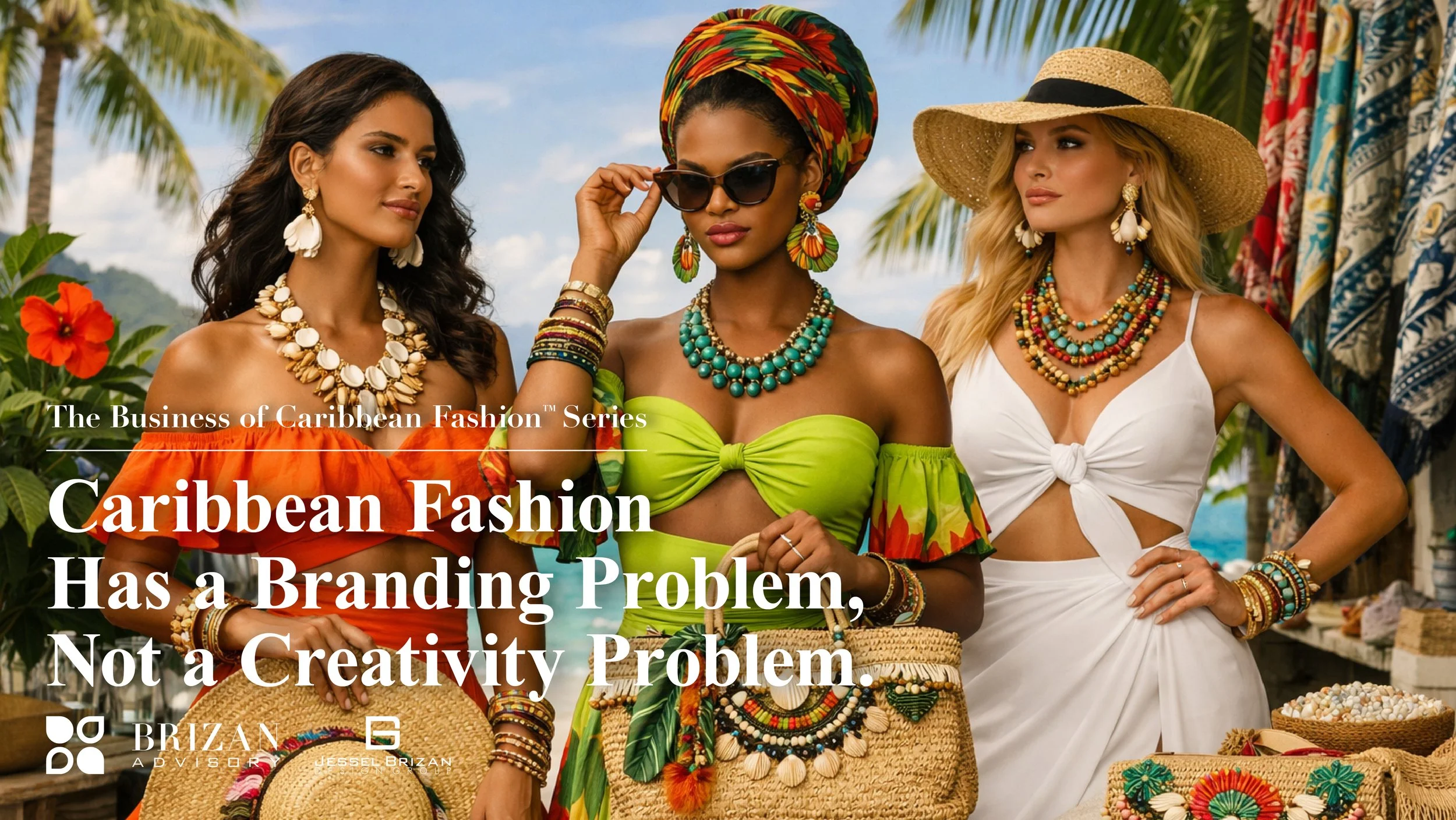
This article is part of our ‘The Business of Caribbean Fashion™’ series, based on Chapter 8 by Jessel Brizan, ‘Caribbean Fashion Marketing: Defining Caribbean Fashion’, in the ‘De Gruyter Handbook of Fashion Marketing’ edited by Olga Mitterfellner (De Gruyter Brill, 2026).
Caribbean music shapes global culture. Caribbean Carnival attracts international attention. Caribbean aesthetics appear regularly in global advertising campaigns, fashion editorials, and luxury resort marketing. Yet despite this extraordinary cultural visibility, Caribbean fashion remains largely absent from the global fashion conversation. That is not a creativity problem. It is a branding problem.
The Caribbean's cultural influence extends far beyond its geographic size. Caribbean music continues to shape global soundscapes through the influence of dancehall, reggae and soca. Trinidad Carnival has evolved into a global phenomenon, with events such as Notting Hill Carnival attracting approximately two million attendees annually and contributing an estimated £400 million to the London economy (Bakare, 2025). Meanwhile, Caribbean aesthetics increasingly appear in luxury tourism campaigns, international fashion editorials, and global hospitality branding, as demonstrated by Sandals Resorts' international "Made of Caribbean" campaign and Vogue's recent spotlight on Jamaican fashion entrepreneurship (PR Newswire, 2024; Boyd-Griffith, 2025). Collectively, these examples illustrate a critical point: the Caribbean has already achieved significant cultural visibility. The challenge is converting that visibility into stronger commercial positioning for Caribbean fashion businesses.
Creativity Is Not the Same as Market Positioning
One of the most persistent myths in fashion is that great products automatically create successful brands. They do not. The global fashion industry is filled with talented designers whose businesses never achieve meaningful scale. Consumers rarely purchase products based solely on quality. They buy identity, meaning, aspiration, belonging, stories, and positioning. This is what is referred to as “perceived value”—the value or benefit a customer feels from purchasing and consuming the product (Brizan, 2020). This is why branding has become one of the most valuable assets in modern business. A handbag is never just a handbag. A dress is never just a dress. Consumers are purchasing what those products represent. The same principle applies to countries, regions, and industries. Markets reward brands that communicate a clear and compelling position.
This is where Caribbean fashion faces a significant challenge. While individual designers often have strong creative identities, the industry itself lacks a widely understood market position. Italian fashion is defined as “altagamma” (high-end) and is associated with craftsmanship, luxury, heritage, and quality. French fashion is noted for “art de vivre” (the art of living) and conveys timelessness, elegance, sophistication, and prestige. Scandinavian fashion is associated with minimalism, functionality, and sustainability. Japanese fashion evokes innovation, experimentation, and design culture. But if you ask people to define Caribbean fashion, the answers become far less consistent. Some may mention vibrant colours and tropical prints, while others might refer to Carnival or resort wear. Many individuals may not have an answer at all. In branding, this lack of consistency can create confusion, which ultimately undermines market value.
The Visibility Paradox
Ironically, the Caribbean already possesses one of the world's strongest cultural brands. Millions of people engage with Caribbean culture every year through tourism, music, Carnival, food, sport, festivals, entertainment, and digital media. As a cultural brand, the region enjoys extraordinary global recognition relative to its size. Yet that recognition rarely translates into commercial visibility for Caribbean fashion businesses. This creates what can be described as a visibility paradox. People know the Caribbean, but they do not automatically associate the Caribbean with fashion. Awareness exists, but association does not. In business terms, the brand equity of the region is not being fully transferred to the fashion sector.
How Global Fashion Regions Built Their Brands
The world's strongest fashion economies did not emerge simply because they had talented designers. They built distinctive positioning over decades. They succeeded because they created clear and repeatable narratives around what they represented. Italy did not become synonymous with luxury by producing clothing alone. It consistently communicated craftsmanship, heritage, and quality over decades. France reinforced its association with prestige, creativity, and luxury. Scandinavian countries positioned themselves around simplicity, sustainability, and functional design. These identities were not accidents. In every case, the industry developed a clear narrative and then repeated it persistently. They were strategic choices that were reinforced by industry, media, education, government, and commerce. Over time, those perceptions became competitive advantages.
The Caribbean's Positioning Challenge
The Caribbean, by contrast, often communicates through products rather than positioning. Designers promote collections, runway shows, photoshoots, and events, but the broader industry has yet to establish a widely accepted narrative about what Caribbean fashion represents in the global marketplace. Consumers increasingly buy into larger narratives. This raises questions that are rarely answered consistently at an industry level.
What does Caribbean fashion stand for?
What unique value does it offer?
Why should international buyers care?
What makes it distinct from every other emerging fashion region?
As a result, international audiences frequently fill the gap with assumptions. Those assumptions often reduce Caribbean fashion to beachwear, resortwear, tropical prints, and Carnival costumes. While these categories are important parts of the industry, they represent only a fraction of the region's creative output. No serious fashion economy allows itself to be defined by a single category. Yet Caribbean fashion frequently finds itself constrained by a narrow commercial narrative that fails to reflect its true diversity and sophistication.
The Branding Gap Is Costing Economic Value
This is not simply a marketing issue. It is an economic issue. This branding gap has real economic consequences. Strong brands command premium prices, attract investment, generate media attention, and create export opportunities. Weak brands are forced to compete primarily on price and struggle to differentiate themselves in saturated markets. The issue is not merely one of perception. More so, it is one of economic value creation. Brand equity is a commercial asset that translates to economic value. This is precisely why countries invest heavily in nation branding, cultural diplomacy, and international promotion. Perception influences purchasing, investment, and tourism decisions, and market access. In a global marketplace, visibility without positioning rarely leads to sustainable commercial success. When regions establish clear positioning, they create advantages in export development, tourism spending, foreign investment, retail partnerships, buyer confidence, and international media coverage.
The encouraging reality is that the Caribbean already has many of the ingredients needed to build a powerful fashion identity. The region offers cultural authenticity, rich storytelling traditions, strong diaspora connections, distinct visual aesthetics, diverse design influences, heritage craftsmanship, and growing interest in sustainability and ethical production. What is lacking is not creativity but a clear and unified expression of value. The challenge lies not in creating new assets, but in organising existing ones into a coherent market narrative that international consumers, buyers, media, and investors can easily understand.
From Geographic Region to Strategic Brand
The Caribbean has not yet fully defined what "Caribbean Fashion" means. And until that definition becomes clearer, the industry will continue to struggle to capture the full value of its creativity. The future opportunity for Caribbean fashion does not lie in becoming another Milan, Paris, London, or Copenhagen. The opportunity lies in becoming more distinctly Caribbean. The strongest brands succeed through differentiation, not imitation. In today’s world, where consumers increasingly value authenticity, originality, and cultural relevance, the Caribbean offers many qualities that global markets actively seek.
What Should the Industry Do Next?
The industry's next phase of growth will require strategic positioning. The Caribbean fashion industry needs a stronger collective narrative. This will require:
Clearer articulation of what Caribbean fashion represents
Defining the industry's unique value proposition
Moving beyond narrow resortwear stereotypes
Strengthening regional storytelling
Greater strategic alignment of fashion with tourism, culture, and trade strategies
Investing in brand-building alongside product development
Developing more thought leadership on Caribbean fashion identity
Most importantly, stakeholders, including designers, educators, policymakers, media organisations, and industry leaders, all have a role to play. The region itself is a brand, and every Caribbean fashion business contributes to shaping how that brand is perceived around the world.
Click here to review The Business of Caribbean Fashion™ series.
Click here to purchase the De Gruyter Handbook of Fashion Marketing.
References:
Bakare, L. (2025) Notting Hill carnival came ‘very close’ to not happening, says chair in funding appeal. Available at: https://www.theguardian.com/culture/2025/aug/22/notting-hill-carnival-london-funding-policing?utm_source=chatgpt.com
Boyd-Griffith, S. (2025) Sweet Like JAM Brings Jamaica’s Thriving Fashion Scene Back Home Again. Available at: https://www.vogue.com/article/sweet-like-jam-jamaica-pop-up-store
Brizan, J. (2020). Costing for Fashion: A Guide for Startups and Small Businesses. Trinidad and Tobago: Brizan Publishing, pp.3-4.
PR Newswire (2024) Sandals Resorts Unveils New Global Brand Campaign, "Made of Caribbean". Available at: https://www.prnewswire.com/news-releases/sandals-resorts-unveils-new-global-brand-campaign-made-of-caribbean-302336350.html?utm_source=chatgpt.com
-
September 2026
- 14 Sept 2026 What Caribbean Fashion Can Learn From K-Beauty and African Fashion 14 Sept 2026
- 7 Sept 2026 Sustainability Could Become Caribbean Fashion’s Global Advantage 7 Sept 2026
- 1 Sept 2026 The Future Caribbean Fashion Consumer Is Digital, Global and Culture-Driven 1 Sept 2026
-
August 2026
- 24 Aug 2026 The Diaspora Is Caribbean Fashion’s Most Powerful Global Distribution Network 24 Aug 2026
- 17 Aug 2026 Why Authenticity Has Become a Commercial Strategy 17 Aug 2026
- 12 Aug 2026 Storytelling Is Caribbean Fashion’s Untapped Superpower 12 Aug 2026
- 10 Aug 2026 Jessel Brizan Design Group Launches Brizan Advisory 10 Aug 2026
- 4 Aug 2026 Cultural Hybridity Is the Caribbean’s Greatest Competitive Advantage 4 Aug 2026
-
July 2026
- 29 Jul 2026 Why Caribbean Fashion Is More Than ‘Tropical Prints’ 29 Jul 2026
- 20 Jul 2026 Caribbean Fashion Must Stop Competing on Price 20 Jul 2026
- 13 Jul 2026 Tourism and Fashion: The Caribbean’s Most Untapped Partnership 13 Jul 2026
- 6 Jul 2026 The Future of Caribbean Fashion Depends on Commercial Education 6 Jul 2026
-
June 2026
- 29 Jun 2026 The Caribbean Fashion Industry Needs More CEOs, Not Just Designers 29 Jun 2026
- 27 Jun 2026 Jessel Brizan Featured in Trinidad Guardian: A Mission to Transform Caribbean Fashion 27 Jun 2026
- 24 Jun 2026 Jessel Brizan Donates Book to UTT Libraries 24 Jun 2026
- 22 Jun 2026 Why Caribbean Fashion Brands Struggle to Scale Internationally 22 Jun 2026
- 15 Jun 2026 Caribbean Fashion Has a Branding Problem, Not a Creativity Problem 15 Jun 2026
- 10 Jun 2026 The Evolution of Jessel Brizan Design Group 10 Jun 2026
- 8 Jun 2026 Fashion Is One of the Caribbean’s Most Undervalued Economic Assets 8 Jun 2026
- 1 Jun 2026 Brizan Contributes to De Gruyter Handbook of Fashion Marketing 1 Jun 2026
- 1 Jun 2026 The Global Fashion Industry Has Been Borrowing From the Caribbean for Decades 1 Jun 2026
-
May 2026
- 26 May 2026 JBDG set to launch ‘The Business of Caribbean Fashion™’ Series 26 May 2026
- 18 May 2026 Wholesale vs Direct-to-Consumer: Which Is Right for You? 18 May 2026
- 11 May 2026 The Follow-Up Strategy That Turns Meetings Into Orders 11 May 2026
- 6 May 2026 Acknowledging ‘Selling Fashion Collections’ 6 May 2026
- 4 May 2026 The 7 Costly Mistakes Designers Make Before Meeting Buyers 4 May 2026
- 1 May 2026 Brizan Awards the SFC Book Giveaway Prize to Naballah Chi 1 May 2026
-
April 2026
- 29 Apr 2026 Jessel Brizan Publishes Third Book 29 Apr 2026
- 27 Apr 2026 Why I Wrote Selling Fashion Collections 27 Apr 2026
- 20 Apr 2026 Total Image Projection: How to Win a Buyer Meeting 20 Apr 2026
- 13 Apr 2026 The Perfect Buyer Meeting Kit 13 Apr 2026
- 9 Apr 2026 How to Research Buyers Before You Pitch 9 Apr 2026
-
March 2026
- 30 Mar 2026 What Buyers Really Look for in a Collection 30 Mar 2026
- 24 Mar 2026 How to Create a Line Plan That Appeals to Buyers 24 Mar 2026
- 23 Mar 2026 Mastering Your Pricing Strategy in Fashion 23 Mar 2026
- 16 Mar 2026 Understanding Design Markets: Where Does Your Brand Truly Sit? 16 Mar 2026
- 3 Mar 2026 Creativity Is Not Enough: Why Fashion Designers Struggle to Sell 3 Mar 2026
-
February 2026
- 24 Feb 2026 Why Design Structure Is the Backbone of a Sellable Fashion Collection 24 Feb 2026
-
October 2025
- 17 Oct 2025 14 Core Principles of Brand Ethos 17 Oct 2025
-
September 2025
- 4 Sept 2025 An Affirmation from Louis Vuitton Beauty, Pt. 2 4 Sept 2025
-
July 2025
- 27 Jul 2025 JBDG Selected for Showcase at Caribbean Investment Forum 2025 27 Jul 2025
-
May 2025
- 7 May 2025 The Blueprint of Fashion Design 7 May 2025
- 3 May 2025 The Five Segments of the Global Fashion Industry 3 May 2025
-
March 2025
- 20 Mar 2025 An Affirmation from Louis Vuitton Beauty 20 Mar 2025
-
September 2023
- 12 Sept 2023 I Heart TT™ 12 Sept 2023
- 3 Sept 2023 Why Companies Value Teamwork 3 Sept 2023
-
August 2023
- 18 Aug 2023 The Power of Purpose, Prayer and Perseverance 18 Aug 2023
-
June 2023
- 11 Jun 2023 The Divine Hierarchy of Life © 11 Jun 2023
-
May 2023
- 31 May 2023 How to Successfully Navigate a Fashion Internship 31 May 2023
-
January 2023
- 4 Jan 2023 Made To Wear™ 4 Jan 2023
-
September 2022
- 7 Sept 2022 The definitive guide to Caribbean fashion selling seasons 7 Sept 2022
-
February 2022
- 3 Feb 2022 Ethos 3 Feb 2022
-
May 2021
- 23 May 2021 The Art of the T 23 May 2021
-
April 2021
- 28 Apr 2021 I Heart TT™ introduces new merch 28 Apr 2021
-
March 2021
- 19 Mar 2021 AUX reveals redesigned logo to mark anniversary 19 Mar 2021
- 11 Mar 2021 AUX introduces digital catalogue 11 Mar 2021
-
December 2020
- 31 Dec 2020 2020: The year that was 31 Dec 2020
-
October 2020
- 4 Oct 2020 Brizan Publishing launches second publication 4 Oct 2020
-
August 2020
- 30 Aug 2020 AUX reveals visuals of proposed concept for Breezes 30 Aug 2020
-
July 2020
- 1 Jul 2020 Brizan Publishing issues first publication 1 Jul 2020
-
June 2020
- 21 Jun 2020 Brizan Publishing readies for launch 21 Jun 2020
-
March 2020
- 10 Mar 2020 I Heart TT gives to Cyril Ross 10 Mar 2020
-
September 2019
- 19 Sept 2019 Biography: Jessel Brizan 19 Sept 2019
-
June 2019
- 30 Jun 2019 Selling Your Collection 30 Jun 2019
-
May 2019
- 26 May 2019 Technical Package Development 26 May 2019
- 19 May 2019 Developing Caribbean fashion 19 May 2019
-
March 2019
- 10 Mar 2019 Introducing AUX 10 Mar 2019
-
February 2019
- 24 Feb 2019 Philanthropy Through Fashion 24 Feb 2019
- 1 Feb 2019 Celebrate with us! 1 Feb 2019
-
September 2018
- 30 Sept 2018 Island Safari Trend Inspiration 30 Sept 2018
-
September 2016
- 5 Sept 2016 Nautropical Trend Inspiration 5 Sept 2016
-
January 2016
- 1 Jan 2016 Humble Origins 1 Jan 2016