
The Future of Caribbean Fashion Depends on Commercial Education
by Jessel Brizan | VALSAYN, Trinidad and Tobago | 6 July 2026

This article is part of our ‘The Business of Caribbean Fashion™’ series, based on Chapter 8 by Jessel Brizan, ‘Caribbean Fashion Marketing: Defining Caribbean Fashion’, in the ‘De Gruyter Handbook of Fashion Marketing’ edited by Olga Mitterfellner (2026 DeGruyter Brill).
The Caribbean fashion industry has focused on teaching people how to design. Perhaps it is time to spend equal energy teaching people how to build businesses. That statement is not intended to diminish the importance of creativity. Design will always remain at the heart of fashion. Without creativity, there is no product, no brand, and no industry. But if the Caribbean is serious about transforming fashion from a creative activity into a meaningful economic sector, it must recognise that talented designers do not automatically create successful fashion businesses. Successful businesses are built on the foundation of commercial capability, which is a skill that can be learned.
The Caribbean fashion industry often frames its challenges in terms of funding, market access, manufacturing capacity, or international visibility. While these issues are undoubtedly important, they are frequently symptoms of a deeper structural challenge. Many fashion entrepreneurs are attempting to navigate increasingly complex global markets without formal training in the commercial disciplines required to build and scale a business. The result is an industry that produces creativity but struggles to consistently produce commercially sustainable businesses.
The Global Fashion Industry Has Evolved
The image of fashion as a purely creative profession is increasingly outdated. Today's fashion leaders operate in an environment shaped by digital commerce, global supply chains, data analytics, sustainability requirements, customer experience management, inventory optimisation, international logistics, and omnichannel retail strategies. In many ways, modern fashion businesses have become as dependent on operational efficiency as they are on creative excellence. The world's most successful brands understand this important fact. They invest heavily in financial planning, supply-chain management, consumer insights, technology, sourcing, inventory control, merchandising, and strategic growth planning. Design remains important, but it is no longer sufficient on its own. The fashion entrepreneur of the future must master the balance between creativity and commerce.
The Missing Curriculum
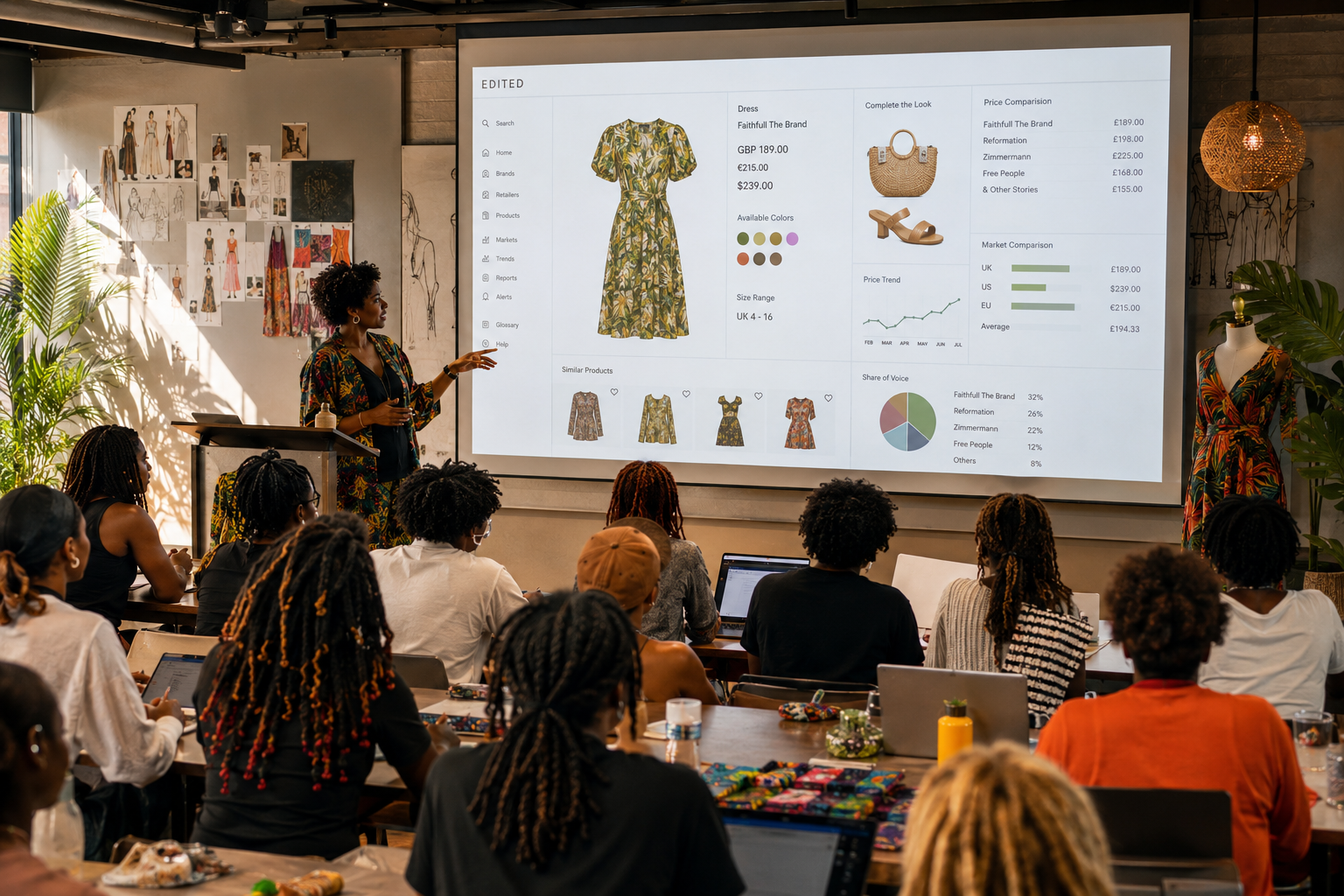
One of the most significant gaps within many fashion education systems is the imbalance between creative training and business training. Students often learn how to sketch, drape, make patterns, sew, construct garments, develop collections, and present their work. While these skills are essential, what is often missing are subjects such as market research, trend analysis, brand strategy, retail mathematics, pricing strategy, supply chain management, inventory planning, digital commerce, financial management, export readiness, intellectual property management, and fashion entrepreneurship. Yet these are precisely the capabilities that are essential for a fashion business to thrive, particularly in its early stages. The issue is not that these topics are unimportant. Rather, the problem is that they are often treated as secondary to design, even though they are equally important.
I can attest to this issue at The Caribbean Academy of Fashion and Design (CAFD) at the University of Trinidad and Tobago (UTT). As the first tertiary-level fashion programme in the Caribbean, CAFD was established to train and develop designers and managers to become future design changemakers, in line with the mandate of an entrepreneurial university. During my second tenure, I was dumbfounded when the programme leader decided to terminate the Diploma in Fashion Management, likely due to low enrolment. In reality, the programme failed to deliver the required learning and development courses tailored to the needs of a nascent industry grounded in strategic expertise, practical application, and measurable entrepreneurial outcomes. Furthermore, the faculty included several instructors who lacked industry experience, business knowledge, or fashion sensibility, which hindered their ability to provide effective instruction. These issues were further exacerbated by a distinct gap between creative and commercial education, highlighted by the disconnect between the design and management programmes.
Why Successful Fashion Economies Invest Beyond Design
The world's leading fashion economies provide a useful lesson. Institutions in countries such as Italy, the United Kingdom, France, and the United States have long recognised that fashion is both a creative and a business discipline. Students studying fashion management, fashion marketing, luxury brand management, merchandising, sourcing, supply-chain operations, and fashion business often outnumber those studying design. This reflects an important insight. Fashion ecosystems require more than designers. They also require buyers, merchandisers, planners, marketers, production managers, sourcing specialists, digital strategists, retail executives, and entrepreneurs. In other words, they require an entire workforce capable of supporting commercial growth. The Caribbean has focused heavily on developing creative talent. The next phase of industry development requires nurturing commercial talent as well.
The Entrepreneurial Reality
Most Caribbean fashion businesses begin as founder-led enterprises. A designer creates a collection, launches a brand, and gradually assumes responsibility for every function within the business. They become the designer, marketer, salesperson, accountant, production manager, logistics coordinator, customer service representative, and the chief executive. While this model is understandable, it is not sustainable. As businesses grow, complexity increases. Inventory control is crucial, cash flow management takes priority, and production schedules become more demanding. Additionally, international buyers expect professionalism and consistency, while digital platforms require data-driven decision-making. Without commercial knowledge, growth often creates pressure faster than it creates opportunity. This is one of the reasons many promising fashion brands struggle to scale. The issue is not creativity but capability.
The Economic Opportunity
This discussion extends beyond individual businesses. If Caribbean governments genuinely view fashion as a tool for economic diversification, then commercial education becomes an economic development issue. A stronger talent pipeline would contribute to higher business success rates, increased export readiness, greater investor confidence, improved operational performance, stronger regional supply chains, increased employment opportunities, and more scalable fashion enterprises. In short, better commercial education would help transform fashion from a collection of individual creatives into a more mature industry ecosystem, with potentially significant long-term economic impact.
Rethinking Fashion Education for the Caribbean
The future of fashion education in the Caribbean should not be a choice between creativity and commerce. It should be a combination of both. Design students should understand business fundamentals, and business students should understand fashion. Fashion programmes should include greater exposure to entrepreneurship, strategic brand management, marketing, digital commerce, financial planning, sourcing, and supply-chain management. Industry partnerships should be developed to connect students with real-world commercial challenges rather than purely academic exercises. And perhaps most importantly, success should be defined more broadly. The objective should not simply be to graduate designers. Rather, it should be to graduate future founders, executives, strategists, innovators, operators, and industry leaders.
Building the Industry We Need
The answer to how the Caribbean fashion industry can become more competitive internationally may begin in the classroom. Industries rarely exceed the abilities of their leaders. If the region wants stronger brands, it needs stronger businesses. If it wants stronger businesses, it needs stronger leadership. And if it wants stronger leadership, it must invest in education that develops commercial capability alongside creative talent. The future of Caribbean fashion will not be determined solely by the next generation of designers. It will be determined by the next generation of entrepreneurs, strategists, marketers, and executives who know how to transform creativity into economic value. The Caribbean needs more business-minded fashion professionals, not fewer designers. Creativity is important for starting a fashion business, but commercial education is what helps it grow.

Archive
- October 2026
- September 2026
- August 2026
- July 2026
- June 2026
- May 2026
- April 2026
- March 2026
- February 2026
- October 2025
- September 2025
- July 2025
- May 2025
- March 2025
- September 2023
- August 2023
- June 2023
- May 2023
- January 2023
- September 2022
- February 2022
- May 2021
- April 2021
- March 2021
- December 2020
- October 2020
- August 2020
- July 2020
- June 2020
- March 2020
- September 2019
- June 2019
- May 2019
- March 2019
- February 2019
- September 2018
- September 2016
- January 2016