
How to Create a Line Plan That Appeals to Buyers
by Jessel Brizan | VALSAYN, Trinidad and Tobago | 16 March 2026

This article is part of an ongoing fashion business series, 'Selling Fashion Collections'.
Fashion entrepreneurs often focus on mood boards, lookbooks, and runway moments, while buyers focus on numbers. To gain the respect of retail buyers, your line plan must communicate effectively before you enter a buyer meeting.
In Selling Fashion Collections: Navigating the Buying Process as a Fashion Entrepreneur, I explain that a line plan is not just a formality; it is a strategic document that indicates whether your collection is commercially viable. Let’s break down the key differences between amateur line plans and professional ones.
Clarify Your Market
Before outlining styles, consider the following questions:
What design market are you operating in?
What is your opening price point?
What is your average retail price?
Who is your target customer?
Where would this realistically be displayed in-store?
Buyers assess collections based on retail strategy. If your line plan does not clearly communicate your market position, it can create doubt. Creativity without context appears risky, while creativity within a structured framework feels more appealing to buyers.
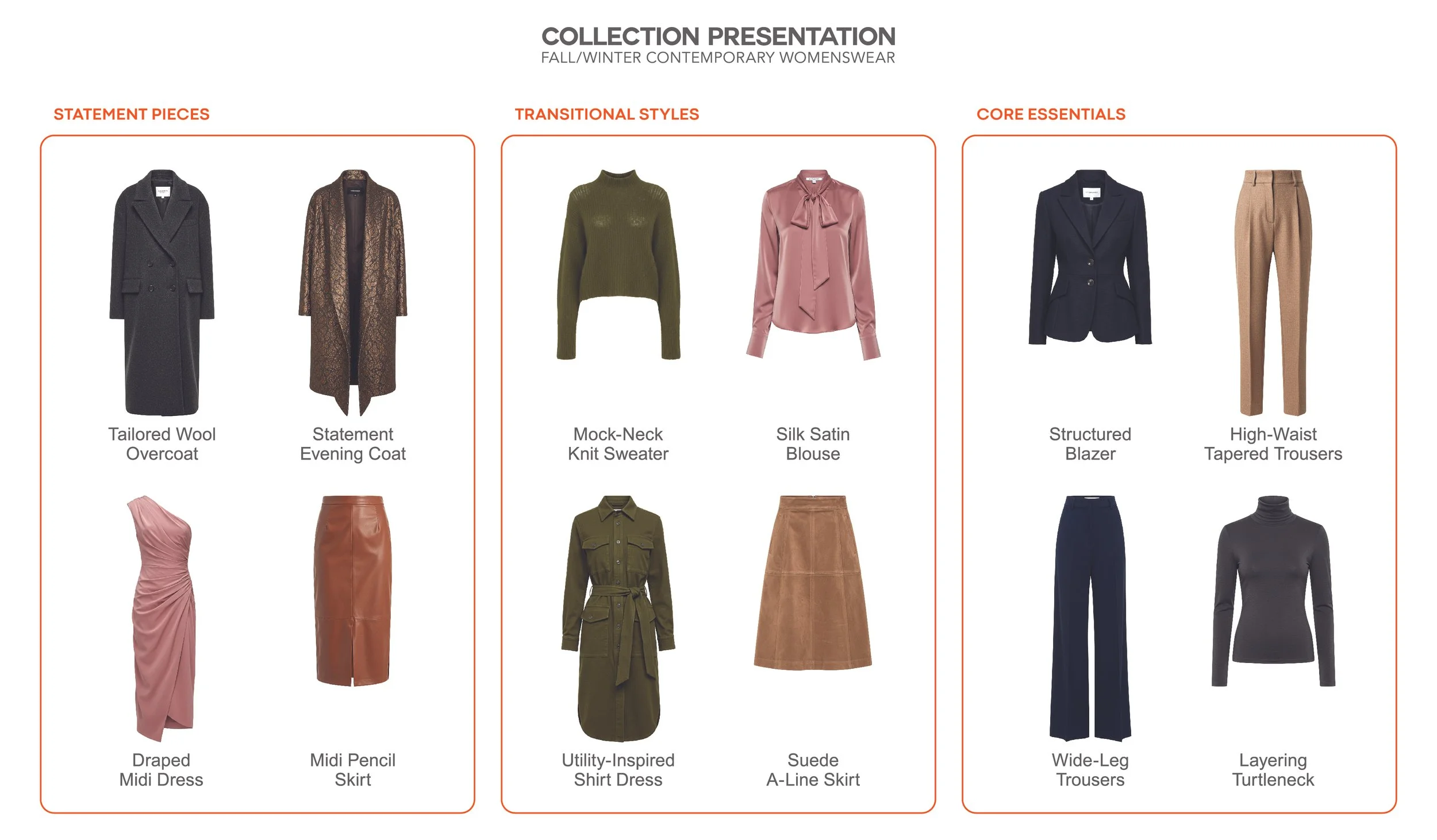
Collection overview for F/W contemporary womenswear collection
Show A Balanced Collection
A common mistake designers make is overloading their collection with statement pieces. Buyers are focused on building assortments that include:
Core revenue drivers
Commercial staples
Margin-supporting items
A few directional pieces
Your line plan should clearly show:
Total number of SKUs (stock-keeping units)
A breakdown by category (e.g., dresses, separates, outerwear)
Fabric distribution
Colour assortment
Price structure
If your collection consists of 60% avant-garde pieces without a solid commercial foundation, buyers may struggle to see the potential for sell-through.
Plan Your Price Structure
One of the quickest ways to lose credibility in retail is through inconsistent pricing. Your line plan should clearly define the following components:
Opening price point
Mid-tier offerings
High-end statement pieces
Average retail price
Retailers assess margins immediately. If your pricing fluctuates erratically without clear justification, it may indicate a lack of experience. A well-structured line plan shows that you understand wholesale math as well as design.
Edit Your Collection
Buyers do not want to curate your collection for you. If you present 42 styles but only 18 are genuinely strong, you weaken your overall presentation. A well-edited 22-piece collection with clear cohesion will always perform better than a disorganised 40-piece offering. Effective editing demonstrates discipline, and discipline builds trust.

Present Your Line Plan Professionally
Your line plan should be clean, structured, and easy to understand. It is not a mood board. It should include the following elements:
Style number
Style name
Category
Fabric
Colour options
Wholesale price
Retail price
Delivery timeline
If a buyer has to search for information, you risk losing momentum. Clarity equals confidence.
Align With Retail Calendars
Even the strongest collections can fail if the delivery timing is unrealistic. Your line plan needs to align with:
Market weeks
Retail floor planning schedules
Seasonal transitions
Production lead times
When buyers recognise that you understand their calendar, you transition from being viewed as merely “creative talent” to becoming a “credible brand partner.”
Think Like a Buyer
Designers tend to think in terms of looks, while buyers think in terms of units. A serious line plan helps retailers envision:
What products would they purchase in large quantities
What items would they experiment with
What styles they would reorder
How items would be merchandised in-store
If your collection does not translate into assortment logic, it will not convert into purchase orders.
The Hidden Reality
A line plan is essentially a financial overview presented as a design document. Its primary purpose is to address one crucial question:
“Will this collection make us money?”
When you can confidently answer this question on paper, the dynamics of buyer meetings change significantly. The focus shifts from uncertainties to discussions about quantities.
If you are preparing to approach retailers and buyers and want to gain insight into the buying process from the seller’s perspective, I explore this topic in much greater detail in my book, Selling Fashion Collections: Navigating the Buying Process as a Fashion Entrepreneur.
Selling Fashion Collections: Navigating the Buying Process as a Fashion Entrepreneur will be available for pre-order on April 8, 2026. The book will ship after April 29, 2026.

A native of the Republic of Trinidad and Tobago, Jessel Brizan is a fashion entrepreneur, educator and author with over two decades of experience in the creative industries, tertiary education, and the global fashion industry. He began his career in New York, working with Macy’s Merchandising Group and Solo Licensing Corporation on brands such as Alfani, Betsey Johnson, and Spalding. A graduate of American International College in Massachusetts, he distinguished himself academically, graduating summa cum laude as class valedictorian. He later pursued formal training in menswear design at the Fashion Institute of Technology, New York, where he deepened his expertise in design, production and merchandising. Jessel pioneered several firsts in the Caribbean fashion landscape. As founder of Jessel Brizan Design Group Ltd., he established the first local fashion e‑commerce platform, enabling global sales and fulfilment. In 2012, he launched Blue Basin Department Stores Ltd., the first local retail concept connecting Caribbean designers and artisans with international markets. He also played a key role in forming The Fashion Exchange Co‑operative Society Limited, the region’s first fashion co‑operative. An educator at heart, he served a decade at the University of Trinidad and Tobago’s Caribbean Academy of Fashion and Design, where he developed and taught courses in digital fashion design, technical illustration, creative fashion presentations and portfolio development. His work introduced the region’s first curricula in digital fashion design and technical package creation. Jessel’s expertise has been sought by FashionTT, the Caribbean Export Development Agency, the National Training Agency and the Trinidad and Tobago Bureau of Standards, where he has contributed to the national standard for sustainable garment manufacturing. In 2023, he was awarded a prestigious Chevening Scholarship and earned a Master’s in Fashion Business Management from the University of Westminster. He continues to advocate for a globally competitive, sustainable Caribbean fashion ecosystem, presenting thought leadership at regional forums such as the Caribbean Investment Forum 2025. As an author, he has published Costing for Fashion and Technical Package Development for Excel, practical guides that support designers and entrepreneurs in navigating the global fashion landscape. Guided by his philosophy of “philanthropy through fashion”, he remains committed to education, industry development and mentoring at‑risk youth.
-
September 2026
- 14 Sept 2026 What Caribbean Fashion Can Learn From K-Beauty and African Fashion 14 Sept 2026
- 7 Sept 2026 Sustainability Could Become Caribbean Fashion’s Global Advantage 7 Sept 2026
- 1 Sept 2026 The Future Caribbean Fashion Consumer Is Digital, Global and Culture-Driven 1 Sept 2026
-
August 2026
- 24 Aug 2026 The Diaspora Is Caribbean Fashion’s Most Powerful Global Distribution Network 24 Aug 2026
- 17 Aug 2026 Why Authenticity Has Become a Commercial Strategy 17 Aug 2026
- 12 Aug 2026 Storytelling Is Caribbean Fashion’s Untapped Superpower 12 Aug 2026
- 10 Aug 2026 Jessel Brizan Design Group Launches Brizan Advisory 10 Aug 2026
- 4 Aug 2026 Cultural Hybridity Is the Caribbean’s Greatest Competitive Advantage 4 Aug 2026
-
July 2026
- 29 Jul 2026 Why Caribbean Fashion Is More Than ‘Tropical Prints’ 29 Jul 2026
- 20 Jul 2026 Caribbean Fashion Must Stop Competing on Price 20 Jul 2026
- 13 Jul 2026 Tourism and Fashion: The Caribbean’s Most Untapped Partnership 13 Jul 2026
- 6 Jul 2026 The Future of Caribbean Fashion Depends on Commercial Education 6 Jul 2026
-
June 2026
- 29 Jun 2026 The Caribbean Fashion Industry Needs More CEOs, Not Just Designers 29 Jun 2026
- 27 Jun 2026 Jessel Brizan Featured in Trinidad Guardian: A Mission to Transform Caribbean Fashion 27 Jun 2026
- 24 Jun 2026 Jessel Brizan Donates Book to UTT Libraries 24 Jun 2026
- 22 Jun 2026 Why Caribbean Fashion Brands Struggle to Scale Internationally 22 Jun 2026
- 15 Jun 2026 Caribbean Fashion Has a Branding Problem, Not a Creativity Problem 15 Jun 2026
- 10 Jun 2026 The Evolution of Jessel Brizan Design Group 10 Jun 2026
- 8 Jun 2026 Fashion Is One of the Caribbean’s Most Undervalued Economic Assets 8 Jun 2026
- 1 Jun 2026 Brizan Contributes to De Gruyter Handbook of Fashion Marketing 1 Jun 2026
- 1 Jun 2026 The Global Fashion Industry Has Been Borrowing From the Caribbean for Decades 1 Jun 2026
-
May 2026
- 26 May 2026 JBDG set to launch ‘The Business of Caribbean Fashion™’ Series 26 May 2026
- 18 May 2026 Wholesale vs Direct-to-Consumer: Which Is Right for You? 18 May 2026
- 11 May 2026 The Follow-Up Strategy That Turns Meetings Into Orders 11 May 2026
- 6 May 2026 Acknowledging ‘Selling Fashion Collections’ 6 May 2026
- 4 May 2026 The 7 Costly Mistakes Designers Make Before Meeting Buyers 4 May 2026
- 1 May 2026 Brizan Awards the SFC Book Giveaway Prize to Naballah Chi 1 May 2026
-
April 2026
- 29 Apr 2026 Jessel Brizan Publishes Third Book 29 Apr 2026
- 27 Apr 2026 Why I Wrote Selling Fashion Collections 27 Apr 2026
- 20 Apr 2026 Total Image Projection: How to Win a Buyer Meeting 20 Apr 2026
- 13 Apr 2026 The Perfect Buyer Meeting Kit 13 Apr 2026
- 9 Apr 2026 How to Research Buyers Before You Pitch 9 Apr 2026
-
March 2026
- 30 Mar 2026 What Buyers Really Look for in a Collection 30 Mar 2026
- 24 Mar 2026 How to Create a Line Plan That Appeals to Buyers 24 Mar 2026
- 23 Mar 2026 Mastering Your Pricing Strategy in Fashion 23 Mar 2026
- 16 Mar 2026 Understanding Design Markets: Where Does Your Brand Truly Sit? 16 Mar 2026
- 3 Mar 2026 Creativity Is Not Enough: Why Fashion Designers Struggle to Sell 3 Mar 2026
-
February 2026
- 24 Feb 2026 Why Design Structure Is the Backbone of a Sellable Fashion Collection 24 Feb 2026
-
October 2025
- 17 Oct 2025 14 Core Principles of Brand Ethos 17 Oct 2025
-
September 2025
- 4 Sept 2025 An Affirmation from Louis Vuitton Beauty, Pt. 2 4 Sept 2025
-
July 2025
- 27 Jul 2025 JBDG Selected for Showcase at Caribbean Investment Forum 2025 27 Jul 2025
-
May 2025
- 7 May 2025 The Blueprint of Fashion Design 7 May 2025
- 3 May 2025 The Five Segments of the Global Fashion Industry 3 May 2025
-
March 2025
- 20 Mar 2025 An Affirmation from Louis Vuitton Beauty 20 Mar 2025
-
September 2023
- 12 Sept 2023 I Heart TT™ 12 Sept 2023
- 3 Sept 2023 Why Companies Value Teamwork 3 Sept 2023
-
August 2023
- 18 Aug 2023 The Power of Purpose, Prayer and Perseverance 18 Aug 2023
-
June 2023
- 11 Jun 2023 The Divine Hierarchy of Life © 11 Jun 2023
-
May 2023
- 31 May 2023 How to Successfully Navigate a Fashion Internship 31 May 2023
-
January 2023
- 4 Jan 2023 Made To Wear™ 4 Jan 2023
-
September 2022
- 7 Sept 2022 The definitive guide to Caribbean fashion selling seasons 7 Sept 2022
-
February 2022
- 3 Feb 2022 Ethos 3 Feb 2022
-
May 2021
- 23 May 2021 The Art of the T 23 May 2021
-
April 2021
- 28 Apr 2021 I Heart TT™ introduces new merch 28 Apr 2021
-
March 2021
- 19 Mar 2021 AUX reveals redesigned logo to mark anniversary 19 Mar 2021
- 11 Mar 2021 AUX introduces digital catalogue 11 Mar 2021
-
December 2020
- 31 Dec 2020 2020: The year that was 31 Dec 2020
-
October 2020
- 4 Oct 2020 Brizan Publishing launches second publication 4 Oct 2020
-
August 2020
- 30 Aug 2020 AUX reveals visuals of proposed concept for Breezes 30 Aug 2020
-
July 2020
- 1 Jul 2020 Brizan Publishing issues first publication 1 Jul 2020
-
June 2020
- 21 Jun 2020 Brizan Publishing readies for launch 21 Jun 2020
-
March 2020
- 10 Mar 2020 I Heart TT gives to Cyril Ross 10 Mar 2020
-
September 2019
- 19 Sept 2019 Biography: Jessel Brizan 19 Sept 2019
-
June 2019
- 30 Jun 2019 Selling Your Collection 30 Jun 2019
-
May 2019
- 26 May 2019 Technical Package Development 26 May 2019
- 19 May 2019 Developing Caribbean fashion 19 May 2019
-
March 2019
- 10 Mar 2019 Introducing AUX 10 Mar 2019
-
February 2019
- 24 Feb 2019 Philanthropy Through Fashion 24 Feb 2019
- 1 Feb 2019 Celebrate with us! 1 Feb 2019
-
September 2018
- 30 Sept 2018 Island Safari Trend Inspiration 30 Sept 2018
-
September 2016
- 5 Sept 2016 Nautropical Trend Inspiration 5 Sept 2016
-
January 2016
- 1 Jan 2016 Humble Origins 1 Jan 2016