
Fashion Is One of the Caribbean’s Most Undervalued Economic Assets
by Jessel Brizan | VALSAYN, Trinidad and Tobago | 8 June 2026
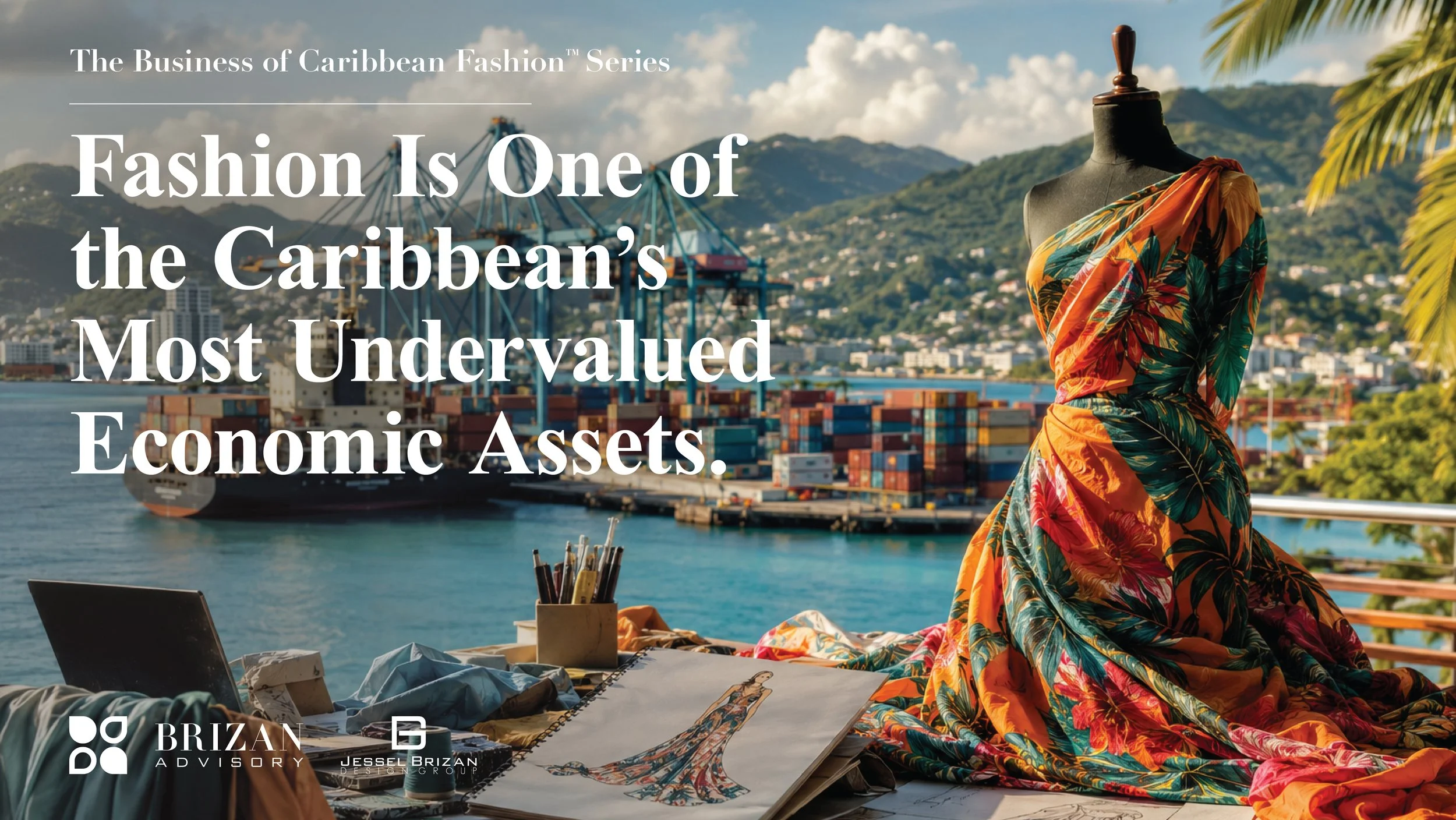
This article is part of our ‘The Business of Caribbean Fashion™’ series, based on Chapter 8 by Jessel Brizan, ‘Caribbean Fashion Marketing: Defining Caribbean Fashion’, in the ‘De Gruyter Handbook of Fashion Marketing’ edited by Olga Mitterfellner (De Gruyter Brill, 2026).
The Caribbean fashion industry is home to talented individuals who showcase immense creativity and potential. However, it faces a significant challenge due to a lack of sustainable investment. For decades, fashion has been treated across much of the region as an aesthetic pursuit, a cultural activity, a creative hobby, or an entertainment category. At the same time, some of the world’s most competitive economies view fashion as part of their trade policy.
This distinction is significant because when governments view fashion as culture, they allocate funds for events. Conversely, when they see fashion as an industry, they develop ecosystems. And ecosystems lead to job creation, exports, investments, and overall economic growth and diversification. The Caribbean has spent years debating whether fashion is worthy of support. A more pertinent question is:
Can the region afford to keep undervaluing it?
Fashion Is Not a Creative Niche. It Is an Economic Sector.
Globally, fashion sits at the intersection of technology, manufacturing, logistics, exports, retail, media, education, tourism, and culture. Its economic impact extends far beyond clothing. According to the UK Fashion & Textile Association and Oxford Economics, the UK fashion and textile industry contributes approximately £62 billion to GDP, supports 1.3 million jobs, and generates more than £23 billion in tax revenues (UKFT, 2023). The industry accounts for roughly one in every 25 jobs in the United Kingdom (UKFT, 2023). The significance of that data is not the size of the UK economy. It is the fact that policymakers recognise fashion as a strategic economic contributor rather than simply a cultural sector. The same pattern is increasingly visible across global creative economies.
According to UNCTAD's Creative Economy Outlook 2022, global exports of creative services grew from approximately US$487 billion in 2010 to almost US$1.1 trillion in 2020, underscoring the growing economic importance of creative industries in global trade (UNCTAD, 2022). The countries capturing the greatest value are not necessarily those with the most creative talent. They are the ones that build the strongest commercial infrastructure around that talent.
The Real Opportunity Is the Multiplier Effect
One of the most common mistakes in discussions about Caribbean fashion is evaluating the industry only through the lens of designers. Economically, that is far too narrow. Fashion operates as a value chain. A single garment can generate economic activity across design, textile and material sourcing, manufacturing, packaging, photography, marketing, e-commerce, logistics, retail, events, tourism, and digital content creation. This creates what economists call a multiplier effect. The designer is only one participant within a much larger economic system. The countries that successfully scale fashion industries understand this principle. They invest in clusters rather than individuals. They support ecosystems rather than isolated businesses.
INDUSTRY INSIGHT: African Fashion Driving Economic Diversification and Cultural Repositioning
Several African countries are increasingly treating fashion as part of broader creative-economy development strategies. Countries such as Nigeria, South Africa, Rwanda, and Ghana have invested in fashion weeks, manufacturing initiatives, creative-industry policies, and local textile development. According to UNESCO, Africa's fashion industry currently generates approximately US$15.5 billion annually in exports (Asadu, 2023). Moreover, with stronger infrastructure and investment, the sector could potentially triple in value over the next decade (Asadu, 2023). Many African countries are transitioning from exporting culture as symbolism to exporting culture as a commercial enterprise. This shift is increasingly becoming a competitive advantage. African fashion initiatives are being used to:
Reduce dependence on raw-material exports
Increase value-added manufacturing
Create employment
Strengthen cultural identity
Improve international visibility
The Caribbean Already Has Proof of Concept
Ironically, the Caribbean already possesses a functioning example of fashion's economic power. Carnival. Too often, Carnival is discussed primarily as culture. Essentially, Carnival is fashion as performance art. Economically, it functions as a temporary fashion industry. Designers, costume makers, textile suppliers, manufacturers, beauty professionals, photographers, content creators, transportation providers, event companies, hospitality operators, and tourism stakeholders all participate in a single integrated value chain.
In Trinidad and Tobago alone, Carnival generates hundreds of millions of dollars in economic activity and supports thousands of jobs across multiple sectors (Trinidad and Tobago Guardian, 2025). Yet despite this annual demonstration of fashion-led economic activity, the region rarely treats fashion as a year-round industrial opportunity. Instead, Carnival is often viewed as an event. The more strategic perspective is to view it as evidence. Evidence that Caribbean creative industries already possess commercial potential when supported by market demand, infrastructure, and consumer spending.
Why This Matters for Economic Development
Many Caribbean economies continue to face similar structural challenges, including economic concentration, dependence on imports, vulnerability to foreign-exchange fluctuations, high youth unemployment, and limited export diversification. Fashion alone cannot solve these issues, but it can play a significant role in contributing to solutions. Unlike heavy industries, fashion has relatively low barriers to entry. Additionally, it benefits from digital distribution, which sets it apart from many traditional sectors. Instead of relying solely on scale, fashion creates value through differentiation. Furthermore, unlike many traditional exports, fashion can enhance national branding while generating revenue. This aspect is particularly important for small island economies that compete in a global marketplace. The future competitiveness of many countries will increasingly depend on their investment in and management of intangible assets, with fashion uniquely situated at the intersection of intellectual property, creativity, brand equity, cultural influence, and digital commerce.
What a Caribbean Fashion Industry Strategy Could Look Like
The next phase of development requires moving beyond event-based support toward industry-building. That means shifting focus toward EXPERT-led:
Tax exemptions on raw material imports
Production infrastructure
Manufacturing partnerships
Fashion business education
Trade development
Export readiness programmes
Digital commerce capabilities
Regional supply-chain integration
Investment incentives for creative industries
Fashion-tourism partnerships
Most importantly, governments, investors, universities, and development agencies need to rigorously measure the economic contribution of Caribbean fashion. Industries that are not measured are rarely prioritised. Data shapes policy, which in turn drives investment and growth.
The Bigger Question
The Caribbean's challenge is not a lack of creativity. This has already been validated by global fashion’s obsession with Caribbean aesthetics. The challenge is that the region has not yet built the commercial systems necessary to capture the full economic value of that creativity. The most successful economies recognise that culture and commerce are interconnected. They view culture as vital infrastructure. They understand that creative industries, including fashion, can be significant drivers of exports and economic growth.
The Caribbean's future competitiveness may depend less on what it produces and more on what it uniquely represents. Fashion is not one of the region's smallest industries waiting to grow. It may already be one of its most valuable economic assets waiting to be recognised.
Click here to review The Business of Caribbean Fashion™ series.
De Gruyter Handbook of Fashion Marketing is available now at: https://www.degruyterbrill.com/document/doi/10.1515/9783111564876/html
References:
Asadu, C. (2023) Africa’s fashion industry is growing to meet global demands but needs more investment, UNESCO says. Available at: https://apnews.com/article/lagos-africa-fashion-unesco-4f791fe7bffe2b84be025e177b529f39
Trinidad and Tobago Guardian (2025) Turning mas into money. Available at: https://www.guardian.co.tt/article/turning-mas-into-money-6.2.2445994.4a7671d485
UKFT (2023) The UK fashion and textile industry contributes £62bn to the UK economy. Available at: https://ukft.org/industry-footprint-report/
UNCTAD (2022) Creative Economy Outlook 2022. Available at: https://unctad.org/publication/creative-economy-outlook-2022?utm_source=chatgpt.com
Archive
- October 2026
- September 2026
- August 2026
- July 2026
- June 2026
- May 2026
- April 2026
- March 2026
- February 2026
- October 2025
- September 2025
- July 2025
- May 2025
- March 2025
- September 2023
- August 2023
- June 2023
- May 2023
- January 2023
- September 2022
- February 2022
- May 2021
- April 2021
- March 2021
- December 2020
- October 2020
- August 2020
- July 2020
- June 2020
- March 2020
- September 2019
- June 2019
- May 2019
- March 2019
- February 2019
- September 2018
- September 2016
- January 2016