
Why Caribbean Fashion Is More Than ‘Tropical Prints’
by Jessel Brizan | VALSAYN, Trinidad and Tobago | 29 July 2026
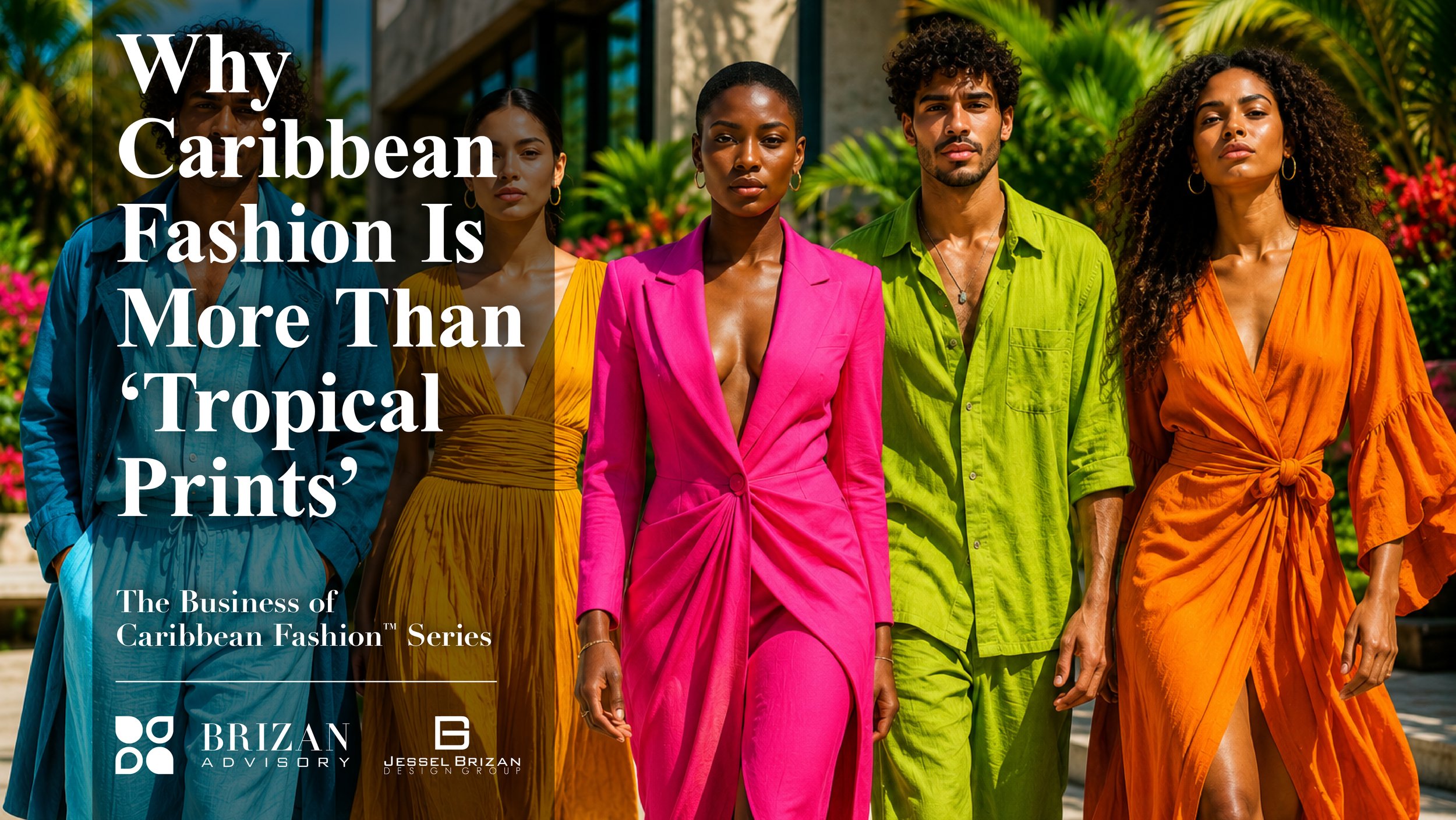
This article is part of our ‘The Business of Caribbean Fashion™’ series, based on Chapter 8 by Jessel Brizan, ‘Caribbean Fashion Marketing: Defining Caribbean Fashion’, in the ‘De Gruyter Handbook of Fashion Marketing’ edited by Olga Mitterfellner (De Gruyter Brill, 2026).
The Myth of the ‘Caribbean Aesthetic’
One of the biggest misconceptions about Caribbean fashion is that it can be reduced to a handful of visual clichés, such as tropical prints, palm trees, bright colours, beachwear, and resort clothing. These elements undoubtedly exist within Caribbean fashion and are part of the region's cultural and environmental landscape. But reducing Caribbean fashion to these visual references is akin to reducing Italian fashion to leather handbags, French fashion to striped shirts, or Japanese fashion to kimonos. It oversimplifies an industry that is far more diverse, sophisticated, and commercially relevant than many people realise. This persistent narrative, which often confines the industry's identity to a narrow aesthetic category, is one of the challenges facing Caribbean fashion today. If Caribbean fashion is to achieve greater international recognition, it must expand the conversation beyond tropical imagery and begin communicating the full depth of its creative, cultural, and commercial capabilities.
The Problem with a Single Narrative
Every successful fashion economy benefits from a strong identity. However, problems emerge when identity becomes a stereotype. Traditionally, international perceptions of the Caribbean have been largely shaped by tourism marketing. Beaches, sunshine, Carnival, and leisure travel have become dominant symbols associated with the region. While these assets have helped attract millions of visitors, they have also influenced how Caribbean creativity is often interpreted internationally. As a result, Caribbean fashion is often viewed through a tourism lens rather than a fashion lens. Designers are frequently expected to produce collections that align with preconceived notions of what Caribbean fashion should look like, rather than being evaluated on the full extent of their creativity. This creates a strategic challenge. When markets expect a particular aesthetic, innovation that falls outside that expectation can be more difficult to position and communicate.
Fashion Is a Reflection of Society, Not Climate
One of the most persistent misunderstandings about Caribbean fashion is the assumption that geography alone determines design identity. Fashion is not merely a reflection of the weather. It is a reflection of society. The Caribbean is one of the most culturally diverse regions in the world, shaped by African, Indian, European, Chinese, Indigenous, Middle Eastern, and countless other influences. Its histories encompass migration, trade, resilience, entrepreneurship, innovation, and cultural exchange. The region's fashion, therefore, reflects far more than tropical landscapes. It reflects identity, heritage, urban culture, contemporary lifestyles, social change, and global influences, all interpreted through uniquely Caribbean perspectives. To define Caribbean fashion solely by tropical aesthetics is to overlook the richness of the societies that produce it.
The World's Most Successful Fashion Regions Evolved Beyond Stereotypes
History shows that successful fashion economies rarely allow themselves to be defined by a single visual narrative. Italian fashion is not limited to traditional tailoring. French fashion extends far beyond haute couture. Japanese fashion encompasses everything from luxury craftsmanship to avant-garde experimentation. South Korean fashion has evolved alongside technology, youth culture, entertainment, and global consumer trends. These industries succeeded because they continually expanded their perception in the global economy. They built reputations around creativity, innovation, quality, craftsmanship, and cultural relevance rather than relying exclusively on familiar stereotypes. The Caribbean faces a similar challenge. Its future competitiveness will depend on broadening perceptions of what Caribbean fashion is or could be.
The Caribbean's Emerging Design Diversity
A closer look at the region reveals a fashion landscape that is far more diverse than commonly portrayed. Across the Caribbean, designers are producing contemporary ready-to-wear collections, luxury eveningwear, menswear, streetwear, sustainable fashion, textile innovations, artisanal products, and culturally inspired designs that extend well beyond resort wear. Some brands draw inspiration from architecture, while others explore heritage and identity. Many engage with sustainability, circular fashion, social impact, craftsmanship, and modern lifestyles. These brands are not competing solely within a Caribbean category. They are participating in broader global conversations about design, culture, and consumer behaviour. Yet these stories often receive less attention than the familiar imagery associated with tropical motifs.
Why This Matters Commercially
At first glance, this may appear to be a branding issue, but in reality, it is a matter of market positioning. When an industry is defined too narrowly, it risks limiting the types of customers, buyers, investors, and partners it can attract. If Caribbean fashion is viewed primarily as vacation wear, it may struggle to compete in categories such as luxury, contemporary fashion, business apparel, streetwear, lifestyle products, or global e-commerce. This narrows commercial opportunities. Broader perceptions lead to expanded markets. A broader industry identity enhances its ability to cater to diverse consumer segments and participate in global value chains. In business terms, diversification creates growth opportunities. The same principle applies to brand positioning.
Reframing the Caribbean Fashion Narrative
The next phase of Caribbean fashion development requires a more sophisticated narrative. Rather than abandoning tropical influences, the industry should place them within a much broader context. The conversation should include cultural heritage, craftsmanship, contemporary design, sustainability, innovation, entrepreneurship, digital commerce, luxury positioning, creative industries, and global competitiveness. In other words, Caribbean fashion should be presented not as a niche aesthetic category but as a dynamic and evolving industry. This requires collaboration among designers, educators, media organisations, fashion councils, development agencies, and policymakers. The narratives we create about Caribbean fashion shape global perceptions, which, in turn, influence opportunities.
The Opportunity Ahead
The Caribbean does not need to reject its cultural identity. On the contrary, its cultural distinctiveness remains one of its greatest competitive advantages. However, cultural identity should not be confused with creative limitation. The world's most respected fashion industries are those that continually evolve while remaining true to their identity. Similarly, the Caribbean is at a pivotal point in its fashion industry. Its future will not be defined by whether it can produce more tropical prints. Rather, it will depend on demonstrating that Caribbean fashion is more nuanced and sophisticated, and that it carries greater commercial significance than a single aesthetic stereotype. The Caribbean is not a trend. It is not a colour palette, nor is it a destination theme. It is a region of creators, entrepreneurs, innovators, and storytellers whose work deserves to be understood in its full complexity. The challenge facing Caribbean fashion is not to escape its identity. It is to expand the world's understanding of it. The Caribbean's greatest creative opportunity begins when we stop allowing others to define what Caribbean fashion looks like.
Click here to review The Business of Caribbean Fashion™ series.
Click here to order a copy of the De Gruyter Handbook of Fashion Marketing.

Archive
- September 2026
- August 2026
- July 2026
- June 2026
- May 2026
- April 2026
- March 2026
- February 2026
- October 2025
- September 2025
- July 2025
- May 2025
- March 2025
- September 2023
- August 2023
- June 2023
- May 2023
- January 2023
- September 2022
- February 2022
- May 2021
- April 2021
- March 2021
- December 2020
- October 2020
- August 2020
- July 2020
- June 2020
- March 2020
- September 2019
- June 2019
- May 2019
- March 2019
- February 2019
- September 2018
- September 2016
- January 2016