
Storytelling Is Caribbean Fashion’s Untapped Superpower
by Jessel Brizan | VALSAYN, Trinidad and Tobago | 12 August July 2026
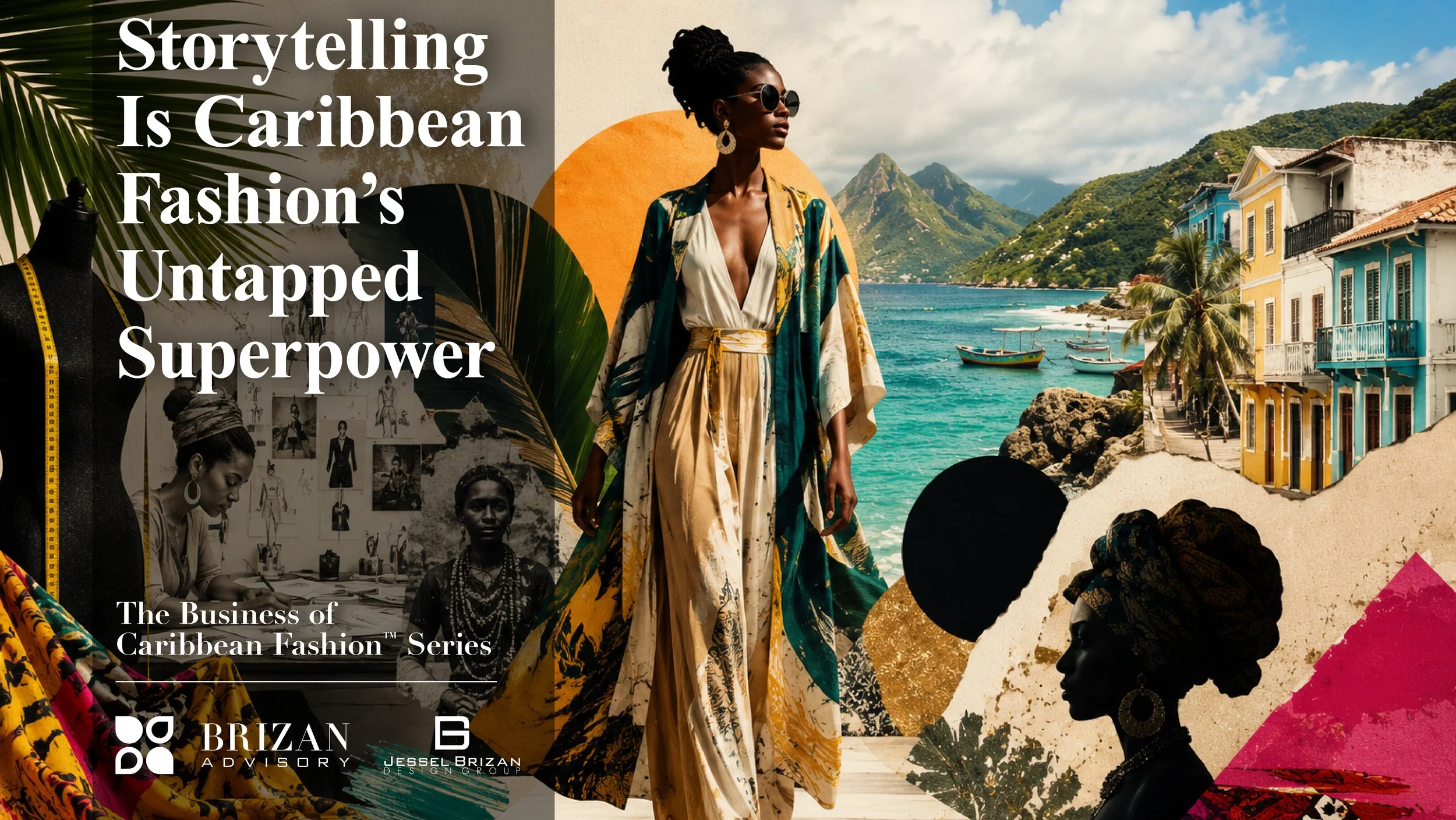
This article is part of our ‘The Business of Caribbean Fashion™’ series, based on Chapter 8 by Jessel Brizan, ‘Caribbean Fashion Marketing: Defining Caribbean Fashion’, in the ‘De Gruyter Handbook of Fashion Marketing’ edited by Olga Mitterfellner (De Gruyter Brill, 2026).
Across the Caribbean, designers create collections inspired by histories of migration, resilience, craftsmanship, cultural fusion, entrepreneurship, and identity. However, too often, these stories remain untold, underdeveloped, or disconnected from the brands they are intended to strengthen. The result is that many Caribbean fashion businesses sell products when they should be selling narratives. And in today's fashion economy, narratives are often worth more than products. The brands winning globally are not necessarily those with the best garments. They are the brands that communicate meaning most effectively. For Caribbean fashion, this represents one of the greatest untapped opportunities for growth.
The New Currency of Fashion Is Meaning
The global fashion industry has undergone a fundamental shift. For much of the twentieth century, brands competed primarily through product, distribution, and advertising. Today, consumers have access to more products than ever before. Digital commerce has democratised access to fashion, making it increasingly difficult for brands to differentiate solely through products. As a result, meaning has become a competitive advantage. Consumers increasingly want to know where products come from, who made them, what they represent, and why they matter.
Research from global consulting firms and consumer insights organisations consistently shows that younger consumers are placing greater importance on authenticity, purpose, values, and brand narratives when making purchasing decisions. Products may attract attention, but stories build emotional connection. And emotional connection drives loyalty. This shift is particularly important for Caribbean fashion because storytelling is one of the few competitive advantages that cannot be easily copied.
The Caribbean Is Rich in Stories but Poor in Storytelling
The irony is that few regions possess more compelling stories than the Caribbean. The region's history is one of extraordinary cultural exchange. African, Indian, European, Chinese, Indigenous, and Middle Eastern influences have intersected for centuries, creating societies defined by resilience, reinvention, creativity, and adaptation. These stories are visible everywhere, including Carnival, music, cuisine, language, cottage industries, entrepreneurship, family histories, communities, and cultural traditions. Yet many Caribbean fashion brands continue to communicate primarily through products rather than narratives. Websites focus on collections, social media highlights garments, and marketing focuses on aesthetics. However, the deeper stories that lend meaning to those products often go unnoticed. This represents a missed commercial opportunity because consumers rarely connect emotionally with products. They connect emotionally with stories.
The World's Most Valuable Fashion Brands Excel at Storytelling
The global fashion industry offers numerous examples of storytelling as a business strategy. Hermès does not simply sell luxury goods. It tells a story about craftsmanship, heritage, exclusivity, and timeless quality. Patagonia built a global following around environmental responsibility, transparency, and activism. Italian luxury brands frequently associate their products with generations of craftsmanship and artisanal expertise. Japanese brands often communicate narratives rooted in tradition, precision, and cultural philosophy. African luxury brands such as Maxhosa Africa have successfully leveraged heritage, identity, and cultural storytelling to build international recognition. In each case, the product is important, but the story amplifies its value. Customers are not simply buying an item. They are buying meaning.
Storytelling Creates Economic Value
Many entrepreneurs mistakenly view storytelling as a marketing activity. In reality, storytelling is a business strategy. Strong storytelling creates economic value in multiple ways. First, it strengthens differentiation. In crowded markets, stories help brands stand apart from competitors offering similar products. Second, it supports premium pricing. Consumers are often willing to pay more for products that carry cultural significance, authenticity, craftsmanship, or emotional meaning. Third, it improves customer loyalty. People remember stories far longer than they remember product specifications. Fourth, storytelling generates content. Every brand story creates opportunities for social media, public relations, partnerships, media coverage, and customer engagement. Strategically, storytelling increases perceived value without necessarily increasing production costs. That is an extraordinarily powerful business tool.
The Caribbean's Competitive Advantage Is Narrative Depth
The previous article in this series argued that cultural hybridity is one of the Caribbean's greatest competitive advantages. Storytelling is how that advantage becomes visible. The Caribbean's diversity creates extraordinary narrative depth. A single collection might draw inspiration from migration histories, indigenous knowledge, African heritage, Indian traditions, Carnival craftsmanship, or contemporary urban culture. These are not simply design influences. They are stories. And stories create meaning. The challenge is that many brands assume these narratives are already obvious. They are not. Global audiences cannot appreciate stories they have never been told.
From Product-Focused Brands to Story-Centric Brands
One of the most important strategic shifts Caribbean fashion businesses can make is moving from product-focused marketing to story-centric branding. This does not mean abandoning design. It means giving consumers a reason to care about the design. Every brand should be able to answer a few fundamental questions:
Why does this brand exist?
What inspired its creation?
What cultural influences shape its perspective?
What values guide its decisions?
What impact does it seek to create?
Why should customers choose this brand over thousands of alternatives?
The answers to these questions form the foundation of meaningful storytelling. Without them, products risk becoming mere commodities.
Building a Storytelling Ecosystem
Storytelling should not be treated as the responsibility of designers alone. Fashion councils, industry associations, media organisations, educators, tourism agencies, and policymakers all have roles to play. The Caribbean needs stronger fashion journalism, including designer profiles, documentaries, behind-the-scenes content, founder stories, and discussions on craftsmanship, innovation, sustainability, and entrepreneurship. The goal should be to create a broader narrative about Caribbean fashion. Industries, like brands, gain strength through storytelling.
The Future Belongs to Brands with Stories Worth Telling
The fashion industry is entering a new era where the significance of products is becoming increasingly important to consumers. With so many choices available, customers often feel overwhelmed. Technology is making it easier to replicate products, and artificial intelligence is speeding up content creation. In this environment, authentic stories are becoming more valuable than ever. The Caribbean is exceptionally well-positioned for this future. Its greatest challenge is not creating stories but telling them consistently, strategically, and confidently. The Caribbean's next generation of fashion success stories will not be built solely on design, craftsmanship, or creativity. They will be built on the ability to connect those strengths to narratives that resonate with the world. The Caribbean fashion industry's greatest untapped asset is not what it creates. It is the stories behind what it creates.
Click here to review The Business of Caribbean Fashion™ series.
Click here to order a copy of the De Gruyter Handbook of Fashion Marketing.

Archive
- September 2026
- August 2026
- July 2026
- June 2026
- May 2026
- April 2026
- March 2026
- February 2026
- October 2025
- September 2025
- July 2025
- May 2025
- March 2025
- September 2023
- August 2023
- June 2023
- May 2023
- January 2023
- September 2022
- February 2022
- May 2021
- April 2021
- March 2021
- December 2020
- October 2020
- August 2020
- July 2020
- June 2020
- March 2020
- September 2019
- June 2019
- May 2019
- March 2019
- February 2019
- September 2018
- September 2016
- January 2016