
Brizan Advisory Announces the Forthcoming Caribbean Fashion Business Index™
by JBDG | VALSAYN, Trinidad and Tobago | 19 October 2026

How are Caribbean fashion businesses performing? It may seem like a simple question, yet the region lacks consistent, comparable business-level data to provide an intelligent answer.
How many Caribbean fashion businesses are commercially viable? What factors limit their profitability and growth? How well prepared are they to meet the demands of international buyers? And what evidence should inform decisions on investment, enterprise support, and industry development?
Without consistent evidence, it is difficult to determine how widespread these challenges are, where support is most needed, or which interventions could make the greatest difference.
The Challenge
The Caribbean has abundant creative talent and cultural influence. The fashion industry generates economic activity across manufacturing, textiles, logistics, marketing, digital services, retail, tourism, and creative content, creating multiplier effects that extend well beyond apparel production. Yet, unlike sectors such as tourism or agriculture, the Caribbean lacks a longitudinal benchmarking system to assess the performance, commercial health, and competitiveness of its fashion ecosystem. Global industry reports, including The Business of Fashion and McKinsey’s The State of Fashion, offer valuable perspectives but do not address the operating realities of Caribbean fashion businesses.

The Instrument
The Caribbean Fashion Business Index™ (CFBI) is being developed as the region's first standardised market intelligence and benchmarking initiative designed to address the lack of comparable business-level data on the Caribbean fashion industry. Its purpose is to strengthen understanding of the conditions, capabilities, and challenges that influence fashion business performance across multiple Caribbean territories.
The proposed framework comprises six measurement areas and 24 indicators, intended to provide a consistent basis for assessing business conditions and performance over successive reporting periods as comparable data becomes available.
The initial pilot will test the proposed indicators, assess data availability and refine the methodology required to support meaningful analysis and future comparisons. Findings will undergo independent review before publication, subject to the pilot's data quality and scope.
The pilot will lay the groundwork for a recurring regional index and the proposed Caribbean Fashion Outlook, generating evidence-informed insights to help guide enterprise development, policy decisions, investment priorities, and industry support. The strength and scope of these insights will depend on participation, data quality and the findings of the pilot.

Why a regional index?
Caribbean markets vary in size, infrastructure, production capacity and access to finance, yet remain connected through trade, tourism and cultural exchange. A regional framework can help identify shared challenges while recognising each territory's specific conditions.
The pilot will provide an initial evidence base, not a definitive representation of the entire Caribbean fashion industry. Findings must be interpreted in the context of participation rates, sample demographics, and methodological limitations. Over time, repeated measurement could help entrepreneurs, investors, policymakers, and industry organisations make better-informed decisions.
Why Now
Three key factors highlight why this is the right moment:
A Maturing Sector: Caribbean fashion businesses need more consistent ways to assess performance, identify constraints and communicate their potential.
Growing Policy Interest: Governments and development institutions need stronger evidence to inform creative economy strategies.
A Framework Ready for Piloting: The index framework, handbook, and scoring system are already established and tested, allowing the program to move directly from design to implementation.
What Comes Next
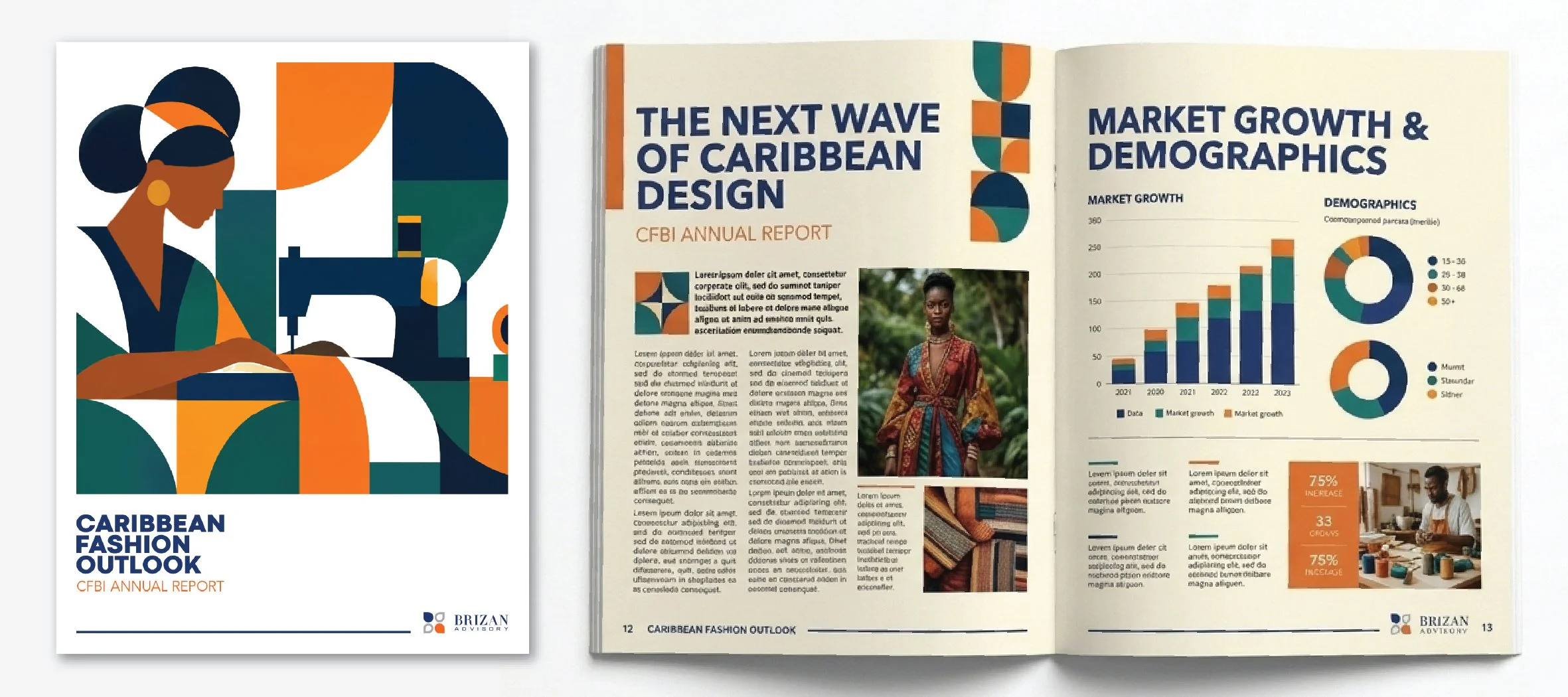
Pilot findings are intended to inform Caribbean Fashion Outlook ©, the proposed CFBI annual report. The methodology will be made publicly available to promote transparency and scrutiny. Over the next 12 weeks, Brizan Advisory will explore the questions underpinning the index:
What criteria should be used to assess a Caribbean fashion business?
How should commercial viability and buyer readiness be evaluated?
What roles should digital capability, sustainability and internationalisation play in assessing business performance?
Through our Building the CFBI series, these conversations will clarify what the region measures, why it matters, and how better evidence can support the industry's development. Better data will not replace creativity. It will make creative businesses more investable. The future of Caribbean fashion requires more than talent. It requires intelligence, and the CFBI is being developed to cultivate that intelligence.
Click here to help build the CFBI.
About Brizan Advisory
Brizan Advisory is the consulting branch of Jessel Brizan Design Group Ltd. It is led by Jessel Brizan, the founder and principal consultant, who is a Caribbean fashion business strategist, entrepreneur, and educator. He is a Chevening Scholar and the author of ‘Selling Fashion Collections: Navigating the Buying Process as a Fashion Entrepreneur,' as well as a chapter in the ‘De Gruyter Handbook of Fashion Marketing.’ Brizan Advisory operates at the intersection of fashion business strategy and the Caribbean creative economy, building the essential data infrastructure the sector needs.

Archive
- October 2026
- September 2026
- August 2026
- July 2026
- June 2026
- May 2026
- April 2026
- March 2026
- February 2026
- October 2025
- September 2025
- July 2025
- May 2025
- March 2025
- September 2023
- August 2023
- June 2023
- May 2023
- January 2023
- September 2022
- February 2022
- May 2021
- April 2021
- March 2021
- December 2020
- October 2020
- August 2020
- July 2020
- June 2020
- March 2020
- September 2019
- June 2019
- May 2019
- March 2019
- February 2019
- September 2018
- September 2016
- January 2016