
Why Caribbean Fashion Needs a Business Index
by Jessel Brizan | VALSAYN, Trinidad and Tobago | 26 October 2026
This article is part of the ‘Building the CFBI’ series from Brizan Advisory.
The Caribbean has a rich fashion narrative, shaped by imaginative designers, industrious manufacturers, resourceful entrepreneurs, and skilled artisans who preserve cultural heritage. The diaspora offers opportunities to reach wider markets beyond the region's 44 million people. Yet the region lacks a sufficiently robust system for measuring the fashion sector's business performance and competitiveness.
If Caribbean fashion is to become a sustainable, globally competitive economic sector, the region must understand how its businesses perform, where they face constraints, and which interventions can help them grow. That requires more than celebrating creative talent. It requires reliable, comparable business intelligence.
The Problem Is Bigger Than Fashion
The challenge of measuring the economic contribution of creative industries extends well beyond fashion. UNESCO's Creative Caribbean programme identifies data intelligence, alongside entrepreneurship, business planning, financing, market access, and institutional strengthening, as important elements of creative-sector development (UNESCO, 2024).
The Caribbean Development Bank (CDB) has also highlighted the consequences of inadequate data collection. In 2024, the Bank reported that data gaps hinder efforts to measure the contribution of cultural and creative industries to Caribbean economies (CDB, 2024). In 2025, it reinforced the importance of data in developing a more sustainable regional creative economy (CDB, 2025).
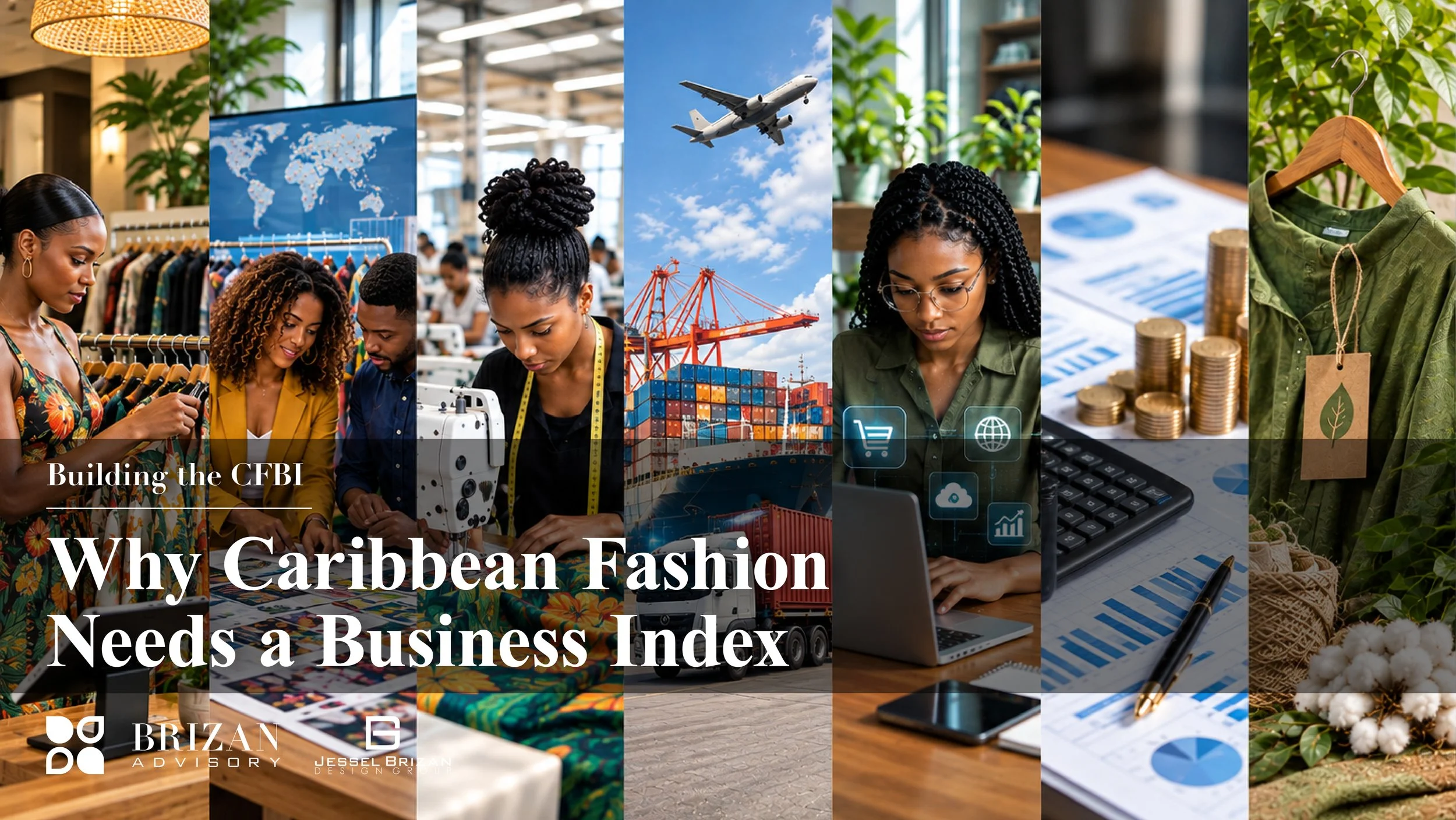
Fashion presents a particular measurement challenge because its economic activity spans design, textiles, manufacturing, marketing, retail, e-commerce, logistics, intellectual property and professional services. Some activities are captured in conventional economic statistics, but the overall performance of fashion businesses can be difficult to assess when information is dispersed across different sources and classifications.
The CDB's Creative Industry Profiles, which cover multiple Caribbean countries, provide an existing foundation for understanding the wider creative economy (CDB, n.d.). The opportunity is to build on this work with a more specialised framework for measuring fashion-business performance.
The Global Opportunity Is Growing
UN Trade and Development's Creative Economy Outlook 2024 estimated that global creative services exports reached US$1.4 trillion in 2022, while creative goods exports amounted to US$713 billion. Creative services exports grew by 29% between 2017 and 2022 (UNCTAD, 2024). Updated UNCTAD data indicate that creative services exports reached approximately US$1.7 trillion in 2024, accounting for 20% of global services trade (UNCTAD, 2026).
These figures represent the broader creative economy rather than fashion alone. They illustrate the international scope of creative trade and underscore the importance of understanding the role of Caribbean businesses within it.
The strategic question is not simply whether Caribbean fashion has international potential, but whether its businesses can compete, reach new markets and capture a greater share of the available opportunities. Answering that question requires evidence of business capabilities, commercial performance and the conditions that support growth.
Why An Index?
Compared with a database, which records information, an index organises selected indicators into a consistent framework for assessing performance and tracking change.
A well-designed Fashion Business Index could bring together measures of commercial viability, market development, production capability, supply chain resilience, digital readiness, financial capacity, sustainability, and export readiness. Its value would depend on clearly defined indicators, a transparent methodology, and the ability to meaningfully compare results over time.
Such a framework would enable the industry to investigate questions that are difficult to answer through isolated studies. Are businesses growing? Are profit margins improving? Is export participation increasing? Are production capabilities expanding? Is access to finance improving? Are industry-development programmes producing measurable results?
The objective is to move from broad claims about the potential of Caribbean fashion towards a more evidence-based understanding of its performance, constraints and opportunities.
Benchmarking Changes Business Decisions
Consider an entrepreneur whose revenue increased by 15% in a year. While this growth seems positive, it lacks meaningful context. If comparable businesses grew by 25%, this entrepreneur's performance is below average. However, if those businesses grew by only 5%, their performance may be comparatively strong.
Benchmarking provides that context. A regional index enables businesses to compare their performance with relevant peers and track progress over time. This shifts the discussion from "Are we doing well?" to "Where are we competitive, where are we falling behind, and how can we improve?" This fosters a more strategic conversation.
This is the value of benchmarking. It places individual business performance in context.
A regional index could help participating businesses compare their performance with relevant peers, identify areas for improvement and track their progress over time. The usefulness of these comparisons would depend on considering differences in business size, market, product category and stage of development.
Instead of asking only whether a business is doing well, entrepreneurs could begin examining where they are competitive, where they are falling behind, and what changes might improve their results.
Policymakers And Investors Need Benchmarks Too
Governments across the Caribbean have supported fashion and other creative industries through grants, training, infrastructure, trade assistance, events, and entrepreneurship programmes. Yet determining which interventions deliver the strongest results can be difficult without reliable sector-specific evidence.
For example, a government might need to choose between subsidising manufacturing equipment, funding export development or expanding business training. Information about the constraints businesses actually face could help policymakers assess these alternatives and direct limited resources more effectively.
Investors face a similar challenge because they are more likely to consider opportunities they can understand and evaluate with confidence. Data cannot eliminate investment risk, but consistent information about business numbers, growth patterns, capabilities, and market participation can support better-informed assessments.
Lenders could also benefit from stronger sector intelligence. Fashion businesses may have operating characteristics that conventional lending assessments do not fully capture, including seasonal sales, inventory cycles, production lead times, and intellectual property. Better information would not resolve every financing barrier, but it could contribute to a more informed assessment of the sector.
The Regional Dimension Is Critical
National fashion indices could provide useful insights, but a regional framework offers an additional perspective. Many Caribbean markets are small, and individual territories may struggle to achieve the scale needed to support every component of a competitive fashion ecosystem independently.
Comparable regional information could help identify opportunities for shared manufacturing infrastructure, cross-border partnerships, coordinated trade support and regional skills development. It could also help distinguish challenges common across the Caribbean from those that require territory-specific solutions.
The purpose of a regional index should not be to identify which country has the "best" fashion industry. It should be to understand differences in performance, investigate the factors behind those differences and identify practices or conditions that might be adapted elsewhere. The objective is to focus on diagnosis and learning, rather than creating a ranking system.
Developing the Caribbean Fashion Business Index™
The Caribbean Fashion Business Index™ (CFBI), being developed by Brizan Advisory, is intended to provide a standardised framework for measuring and benchmarking the business performance and competitiveness of Caribbean fashion businesses.
The initial pilot focuses on four territories. Its purpose is to test the proposed indicators, methodology, data collection processes, and sampling approach, while gathering feedback from participating businesses and reviewers. The findings will help determine what needs to be refined before the framework can support wider regional application.
The pilot is therefore an important development stage, not a claim that a comprehensive or fully representative regional benchmark already exists. Establishing a repeatable system will require methodological discipline, appropriate participation, consistent data collection, and clear communication of the limitations of the findings.
From Measurement to Infrastructure
The longer-term opportunity extends beyond publishing an annual report. If developed and maintained over time, the CFBI could become a regional source of fashion-business intelligence that supports a range of decisions.
Entrepreneurs could use its findings to understand performance and identify development priorities. Governments and development agencies could draw on sector-level evidence when designing and evaluating support programmes. Investors and lenders could gain a clearer picture of market conditions, while researchers and regional organisations could use comparable findings to investigate trends and identify opportunities for collaboration.
Realising this potential will depend on continuity, credibility and trust. The methodology must be transparent, data must be handled responsibly, and findings must reflect the evidence collected rather than assumptions about the industry's expectations.
The Caribbean has spent years promoting its fashion industry and showcasing its creative talent. The next stage of development requires a stronger understanding of how fashion businesses operate, compete and grow. That means shifting from visibility to competitiveness, from individual success stories to sector-wide evidence, and from isolated initiatives towards greater regional cooperation.
The CFBI is being developed to help make that shift possible. Better intelligence will not replace creativity. It will help entrepreneurs, policymakers and investors make better decisions about how to support it. For Caribbean fashion to compete globally, the region needs not only creative talent but also the evidence and infrastructure to turn that talent into sustainable business growth.
Click here to help build the CFBI.
Follow the Building the CFBI series for updates as the Caribbean Fashion Business Index™ pilot progresses toward publication.
References:
Caribbean Development Bank (CDB) (2024) Data Gaps Hindering Measurement of Cultural and Creative Industries Impact on Caribbean Development. Available at: https://www.caribank.org/newsroom/news-and-events/data-gaps-hindering-measurement-cultural-and-creative-industries-impact-caribbean-development
Caribbean Development Bank (CDB) (2025) CDB Champions Data Driven Growth in the Caribbean’s Creative Economy. Available at: https://www.caribank.org/newsroom/news-and-events/cdb-champions-data-driven-growth-caribbeans-creative-economy
Caribbean Development Bank (CDB) (n.d.) The CIIF List - Creative Industry Profiles for the Caribbean. Available at: https://www.caribank.org/publications-and-resources/resource-library/learning-materials/ciif-list-creative-industry-profiles-caribbean
UNESCO (2024) Creative Caribbean. Available at: https://www.unesco.org/en/articles/creative-caribbean
UN Trade and Development (UNCTAD) (2024) Creative Economy Outlook 2024. Available at: https://unctad.org/publication/creative-economy-outlook-2024
UN Trade and Development (UNCTAD) (2026) International trade: Creative goods and services. Available at: https://unctadstat.unctad.org/insights/theme/233
Archive
- October 2026
- September 2026
- August 2026
- July 2026
- June 2026
- May 2026
- April 2026
- March 2026
- February 2026
- October 2025
- September 2025
- July 2025
- May 2025
- March 2025
- September 2023
- August 2023
- June 2023
- May 2023
- January 2023
- September 2022
- February 2022
- May 2021
- April 2021
- March 2021
- December 2020
- October 2020
- August 2020
- July 2020
- June 2020
- March 2020
- September 2019
- June 2019
- May 2019
- March 2019
- February 2019
- September 2018
- September 2016
- January 2016