
The Caribbean Needs a Regional Fashion Strategy
by Jessel Brizan | VALSAYN, Trinidad and Tobago | 5 October 2026
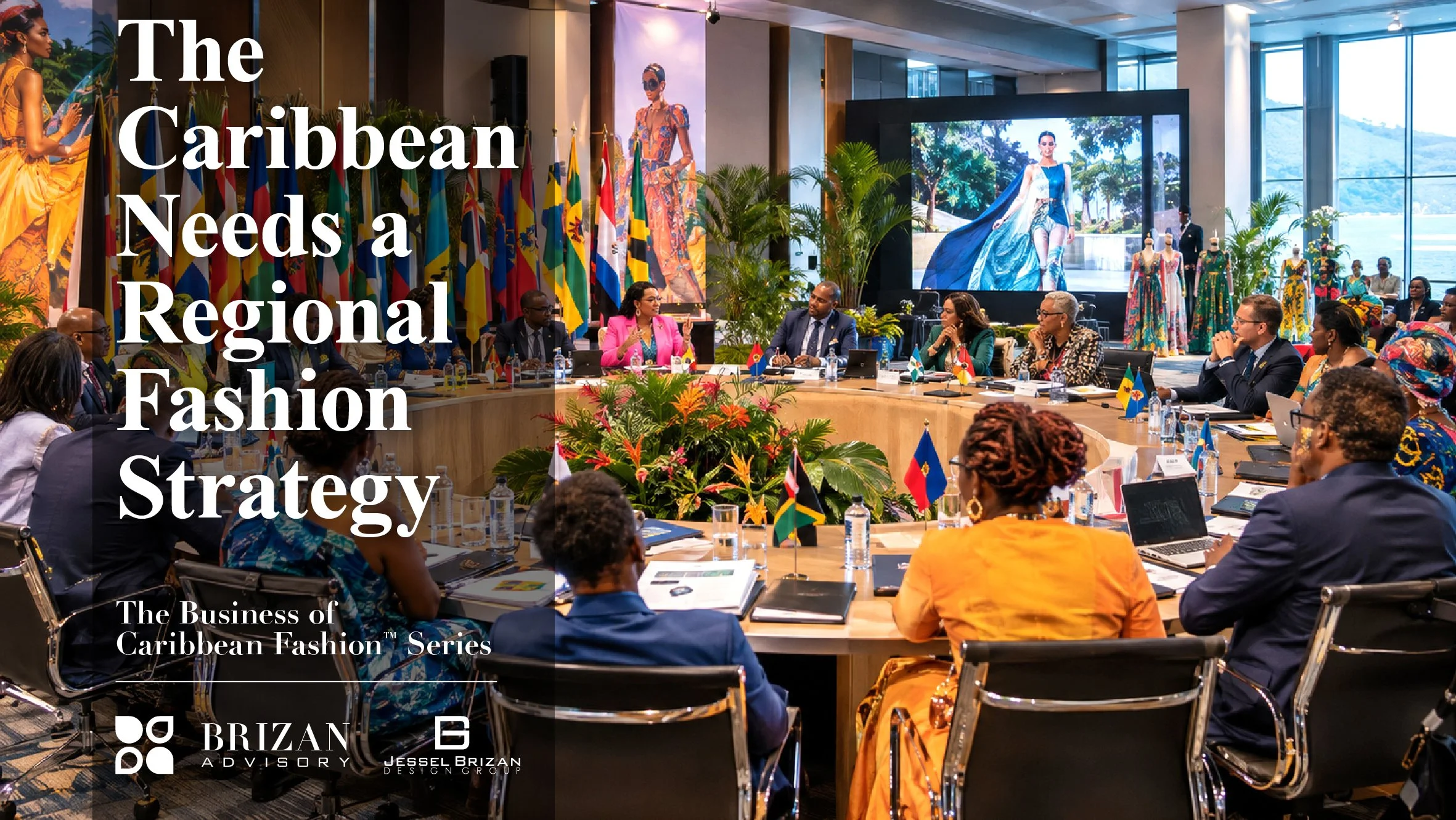
This article is part of our ‘The Business of Caribbean Fashion™’ series, inspired by Chapter 8 by Jessel Brizan, ‘Caribbean Fashion Marketing: Defining Caribbean Fashion’, in the ‘De Gruyter Handbook of Fashion Marketing’ edited by Olga Mitterfellner (De Gruyter Brill, 2026).
For decades, Caribbean countries have invested in developing their own fashion industries, including organising national fashion weeks, supporting local designers, launching export initiatives, and promoting creative entrepreneurship. These efforts have produced talented designers, internationally recognised brands, and moments of global visibility. However, the Caribbean fashion industry collectively remains much smaller than its potential. The reason is that the region has been competing as a collection of small markets when it could be operating as one globally distinctive region. In today's economy, fragmentation is becoming an increasingly expensive strategy.
The Market No Longer Sees Individual Islands
Consumers often overlook political borders when making purchases. Likewise, international buyers do not base their orders on geography. Instead, they are increasingly drawn to regional narratives such as Italian fashion, Scandinavian design, African fashion, Korean beauty, and Japanese craftsmanship. These identities transcend individual cities or companies, functioning as collective brands. The Caribbean already enjoys global recognition as a cultural region, with its music, Carnival, cuisine, sport, tourism, and creative industries widely associated with a shared regional identity, despite the diversity of its individual nations. The fashion industry now has an opportunity to leverage this collective perception. The question is whether the industry is ready to organise around it.
Small Economies Become Stronger Together
Most Caribbean countries have relatively small domestic markets, limited manufacturing capacity, limited access to investment, small pools of specialised talent, and constrained research budgets. While these factors are often seen as structural disadvantages, they can also be viewed as opportunities for regional collaboration. One country may have stronger expertise in textiles, another may offer more advanced fashion education, and another may excel in Carnival design. Additionally, some countries may have better logistics infrastructure, attract more tourism, or possess greater manufacturing capabilities. Competitive ecosystems can emerge when these complementary strengths are connected rather than duplicated.
The World's Most Competitive Industries Are Built on Networks
One of the defining characteristics of globally successful industries is the specialisation found within collaboration. For example, Italy's fashion industry is often regarded as a national success story, but it is built on highly specialised regional production districts. Tuscany is renowned for its leather craftsmanship, Biella for high-quality wool textiles, Como for silk, and Marche for footwear. These interconnected clusters work together to enhance the competitiveness of Italian fashion rather than competing in isolation.
The European Union has also invested in cross-border industrial collaboration, supporting innovation, research, skills development, and sustainability through coordinated programmes that connect businesses, universities, governments, and research institutions. Similar patterns of collaboration can be observed in other regions. The Nordic countries frequently collaborate to promote design while maintaining their distinct national identities.
Additionally, the African Continental Free Trade Area (AfCFTA) is fostering stronger regional value chains and intra-African trade, creating new opportunities for fashion manufacturing and the creative industries. South Korea has successfully coordinated government, education, technology, entertainment, and private industry to develop globally competitive creative sectors. In every case, collaboration has enhanced competitiveness.
The Caribbean Already Operates as a Cultural Ecosystem
One of the most compelling arguments for regional collaboration is the cultural connections already in place between countries. Caribbean music transcends borders, and Carnival traditions influence celebrations throughout the region. Athletes compete under regional identities, and universities collaborate across multiple territories. Regional organisations support cooperation in areas such as trade, education, disaster management, health, and economic development. However, fashion remains one of the few major creative industries that still operates primarily through fragmented national approaches. Although the infrastructure for regional collaboration is already in place, the fashion industry has not yet fully utilised it.
A Regional Strategy Is an Economic Strategy
The previous article argued that investors often misunderstand the Caribbean fashion industry because they tend to assess individual businesses rather than the interconnected ecosystems in which they operate. The same principle applies to regional development. Investors are generally more attracted to scalable markets than to fragmented ones. International buyers prefer efficient sourcing ecosystems to navigating multiple disconnected markets. Development partners often prioritise initiatives with the potential to generate regional impact. Adopting a coordinated Caribbean fashion strategy could enhance the region's appeal by showcasing a larger addressable market, stronger institutional capacity, and more integrated value chains. Therefore, regional collaboration is not just a cultural aspiration. It is also a strategic business approach.
What Could a Caribbean Fashion Strategy Include?
A regional strategy should move beyond symbolic cooperation and focus on building shared competitive capabilities. This could include coordinated efforts in export promotion, regional buyer missions, shared market intelligence, integrated skills development, collaborative manufacturing networks, common sustainability standards, digital trade platforms, regional fashion data collection, and joint international marketing campaigns. The region could also establish centres of excellence, enabling different countries to take the lead in areas where they already have comparative strengths, such as fashion education, Carnival innovation, textile research, digital commerce, sustainable manufacturing, or creative technology. Rather than trying to replicate identical capabilities across every location, the Caribbean could create a distributed ecosystem in which specialisation enhances the strengths of the whole.
Competing Regionally, Winning Globally
Regional collaboration enhances national identity rather than diminishes it. For instance, Italian fashion has not overshadowed the unique identities of Milan, Florence, or Naples. Similarly, Scandinavian design has not erased Danish or Swedish cultures. African fashion has gained global recognition while celebrating the diverse identities of several countries. The Caribbean can achieve a similar balance. Each island can preserve its distinct creative identity while also contributing to a stronger regional brand that boosts international visibility for all. The goal is not uniformity but strategic alignment.
From Projects to Policy
Building a regional fashion industry requires more than occasional collaboration. It demands long-term policy development. Governments should integrate fashion into their regional trade and industrial development agendas. Regional organisations should facilitate data sharing, standards development, export promotion, and industry coordination. Universities should expand collaborative research initiatives and student exchange programmes. Private-sector leaders should build regional supply chains rather than operating solely within national boundaries. Industry associations should collectively advocate for policies that strengthen competitiveness across the Caribbean. Most importantly, fashion should be recognised as an economic development sector rather than merely a cultural activity. Policy shapes industries, and industries shape economies.
The Caribbean's Greatest Competitive Advantage Is the Caribbean
Throughout much of its history, the Caribbean has sought to compete as a collection of small economies. However, the future may demand a different approach. The global market is increasingly competitive, consumers are more connected, investment is more selective, and supply chains are more integrated. No single Caribbean country can easily compete with the scale of the world’s largest fashion economies. Yet collectively, the region possesses significant strengths, including a globally recognised cultural identity, extraordinary creative diversity, a shared history, complementary capabilities, and a unique collective story. The critical question is no longer whether the Caribbean has the talent to build a globally competitive fashion industry, but whether the region is ready to compete as an ecosystem rather than as individual islands. In the twenty-first century, competitive advantage increasingly belongs to networks, not to singular markets.
The future of Caribbean fashion will not be determined by the success of one island. It will be determined by the willingness of many islands to build something larger than themselves.
Click here to review The Business of Caribbean Fashion™ series.
Click here to order a copy of the De Gruyter Handbook of Fashion Marketing.

Archive
- October 2026
- September 2026
- August 2026
- July 2026
- June 2026
- May 2026
- April 2026
- March 2026
- February 2026
- October 2025
- September 2025
- July 2025
- May 2025
- March 2025
- September 2023
- August 2023
- June 2023
- May 2023
- January 2023
- September 2022
- February 2022
- May 2021
- April 2021
- March 2021
- December 2020
- October 2020
- August 2020
- July 2020
- June 2020
- March 2020
- September 2019
- June 2019
- May 2019
- March 2019
- February 2019
- September 2018
- September 2016
- January 2016