
Why Fashion Weeks Alone Will Not Build the Caribbean Fashion Industry
by Jessel Brizan | VALSAYN, Trinidad and Tobago | 21 September 2026
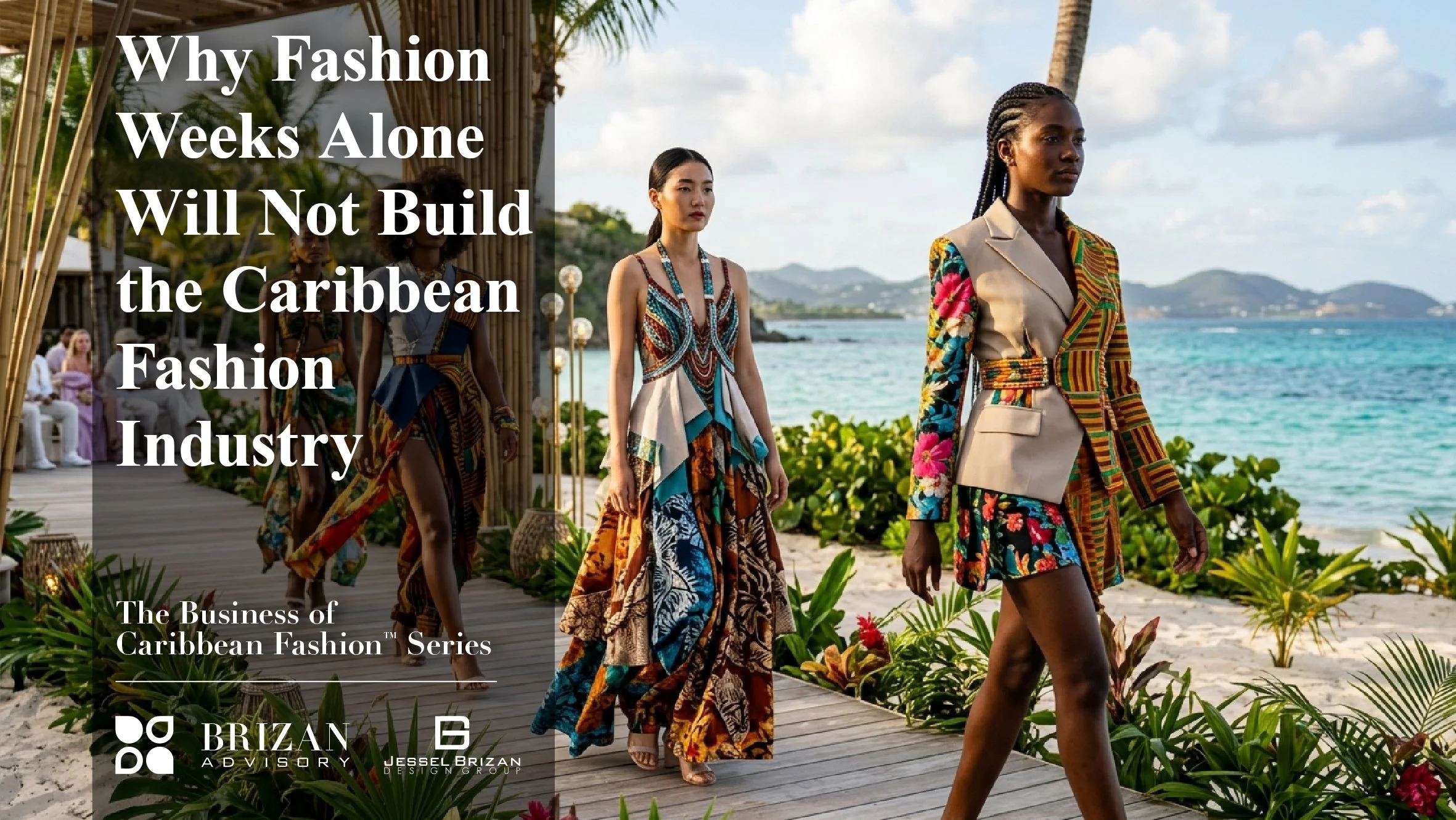
This article is part of our ‘The Business of Caribbean Fashion™’ series, inspired by Chapter 8 by Jessel Brizan, ‘Caribbean Fashion Marketing: Defining Caribbean Fashion’, in the ‘De Gruyter Handbook of Fashion Marketing’ edited by Olga Mitterfellner (De Gruyter Brill, 2026).
In recent decades, the Caribbean fashion industry has experienced the rise and fall of fashion weeks. Ironically, progress in the industry has often been measured by the success of these events. While these achievements deserve recognition, they also raise an uncomfortable question.
If fashion weeks are the engine of industry development, why has the Caribbean fashion industry not scaled proportionately?
The answer is simple. Fashion weeks create visibility while industries create value. These two factors have often been conflated, leading to one of the Caribbean fashion industry's most persistent strategic mistakes. If the region aims to create a globally competitive fashion economy, it must stop viewing fashion weeks as the destination. They are the showroom, not the factory.
Fashion Weeks Were Never Designed to Build Industries
The global fashion calendar has always served an important purpose. Fashion weeks bring together designers, buyers, editors, media, influencers, investors, and consumers to showcase new collections and identify emerging trends. They are powerful marketing platforms that create visibility, media attention, and networking opportunities. But they were never intended to replace the broader infrastructure required for industry development. A runway presentation alone does not address manufacturing challenges, improve access to finance, strengthen export readiness, develop supply chains, train production managers, or guarantee commercial sales. These essential functions are integral to the wider fashion ecosystem.
The World's Leading Fashion Capitals Built Systems First
The success of cities such as Milan, Paris, London, and New York is often associated with their fashion weeks. This perspective overlooks the true relationship. These fashion weeks became influential because they were supported by established fashion ecosystems. Behind every successful runway show are manufacturers, textile suppliers, logistics providers, wholesalers, buyers, retailers, educational institutions, financial services, legal expertise, marketing agencies, technology companies, and government support. The runway is simply the most visible expression of a much larger commercial system.
The same pattern is evident in Seoul. South Korea's growing influence in fashion was supported by coordinated investments in education, digital infrastructure, creative industries, entertainment, export promotion, and innovation long before Korean fashion gained international attention. Likewise, the rise of African fashion has been strengthened not only by fashion weeks in Lagos, Johannesburg, Dakar, and Accra, but also by the development of fashion incubators, manufacturing initiatives, digital commerce, creative entrepreneurship, and international partnerships.
The lesson is consistent. Fashion weeks showcase industries but do not build them.
The Caribbean Tends to Measure the Wrong Success
One of the biggest strategic risks facing Caribbean fashion is the tendency to confuse activity with progress. An industry can host spectacular runway shows while still being commercially vulnerable. It can attract significant media attention while experiencing limited export growth. It can celebrate creativity while overlooking business performance. These issues are not failures of fashion weeks, but rather failures in measurement. The questions Caribbean stakeholders should ask go far beyond attendance figures and social media impressions. Here are some key questions to ask:
How many international buyers attended?
How many designers secured wholesale orders?
How much export revenue was generated?
How many long-term retail partnerships were established?
How much private investment was attracted?
How many jobs were created?
How many businesses experienced growth after participating?
These are the types of metrics that indicate whether an industry is growing.
A Fashion Industry Is an Economic System
Throughout this series, one theme has emerged repeatedly. Fashion is not simply a creative sector. It is an economic system. Successful industries connect various elements:
Education with entrepreneurship
Entrepreneurship with finance
Finance with manufacturing
Manufacturing with logistics
Logistics with export promotion
Export promotion with branding
Branding with digital commerce
Each of these components reinforces the others. When one element is weak, the entire system becomes less competitive. Fashion weeks play a crucial role within this system, but they should not be expected to perform every other function.
Reimagining the Role of Caribbean Fashion Weeks
Caribbean fashion weeks can evolve beyond entertainment or cultural events into comprehensive business platforms. Imagine a regional event where runway presentations are only one component of a broader commercial programme. Alongside the shows, buyers participate in structured sourcing meetings. Investors meet emerging fashion entrepreneurs, while manufacturers showcase production capabilities. Universities present innovative research, technology companies demonstrate digital solutions, and export agencies share valuable market intelligence. Retail executives facilitate supplier matchmaking, banks offer financing solutions, and tourism organisations integrate fashion into destination marketing. Sustainability experts discuss circular business models, while government agencies announce new initiatives. As a result, this platform would transform from a conventional fashion event into a dynamic business marketplace.
Collaboration Is the Key Ingredient
One reason the world's strongest fashion ecosystems outperform smaller industries is their ability to coordinate stakeholders. Fashion is rarely developed solely by designers. It involves collaboration among governments, universities, investors, manufacturers, retailers, logistics providers, technology firms, media organisations, tourism agencies, and industry associations, all working toward common goals. The Caribbean has many of these institutions, but too often they operate independently. The opportunity lies not in creating new organisations but in connecting the existing ones more efficiently. In strategic terms, competitive advantage often comes from effective coordination rather than just operating at a large scale.
Building an Industry Between Fashion Weeks
The most important work often happens after the runway lights are turned off. Collections need to be produced, orders must be fulfilled, retail relationships must be maintained, and working capital needs to be secured. Digital marketing campaigns must continue, employees must be trained, customers must be retained, and export markets must be developed. These activities ultimately determine whether a designer can build a sustainable business. While they receive much less attention than the runway, they generate far greater economic value.
What Caribbean Fashion Should Do Next
The Caribbean should continue investing in fashion weeks, but with a broader purpose. These events should serve as annual catalysts for a year-round strategy focused on industry development. This strategy should include export-readiness programs, development of manufacturing capabilities, fashion business education, investment networks, support for digital commerce, sustainability initiatives, regional collaboration, strengthening supply chains, and industry data collection. Success should not be measured solely by applause at the end of a runway show. Instead, success should be evaluated by the growth and strength of businesses twelve months after the show.
Building More Than Events
Yes, the Caribbean is rich in creative talent, cultural diversity, and compelling stories. But it needs a stronger commercial infrastructure that can transform these strengths into sustained economic growth. Fashion weeks play an important role in this process, but effective systems are essential to build industries. The future of the Caribbean fashion industry will not be determined by the number of fashion weeks it hosts, but rather by the strength of the ecosystem those fashion weeks help build and support. Runway shows may introduce the collection, but ecosystems build the industry.
Click here to review The Business of Caribbean Fashion™ series.
Click here to order a copy of the De Gruyter Handbook of Fashion Marketing.

Archive
- September 2026
- August 2026
- July 2026
- June 2026
- May 2026
- April 2026
- March 2026
- February 2026
- October 2025
- September 2025
- July 2025
- May 2025
- March 2025
- September 2023
- August 2023
- June 2023
- May 2023
- January 2023
- September 2022
- February 2022
- May 2021
- April 2021
- March 2021
- December 2020
- October 2020
- August 2020
- July 2020
- June 2020
- March 2020
- September 2019
- June 2019
- May 2019
- March 2019
- February 2019
- September 2018
- September 2016
- January 2016