
The Diaspora Is Caribbean Fashion’s Most Powerful Global Distribution Network
by Jessel Brizan | VALSAYN, Trinidad and Tobago | 24 August 2026
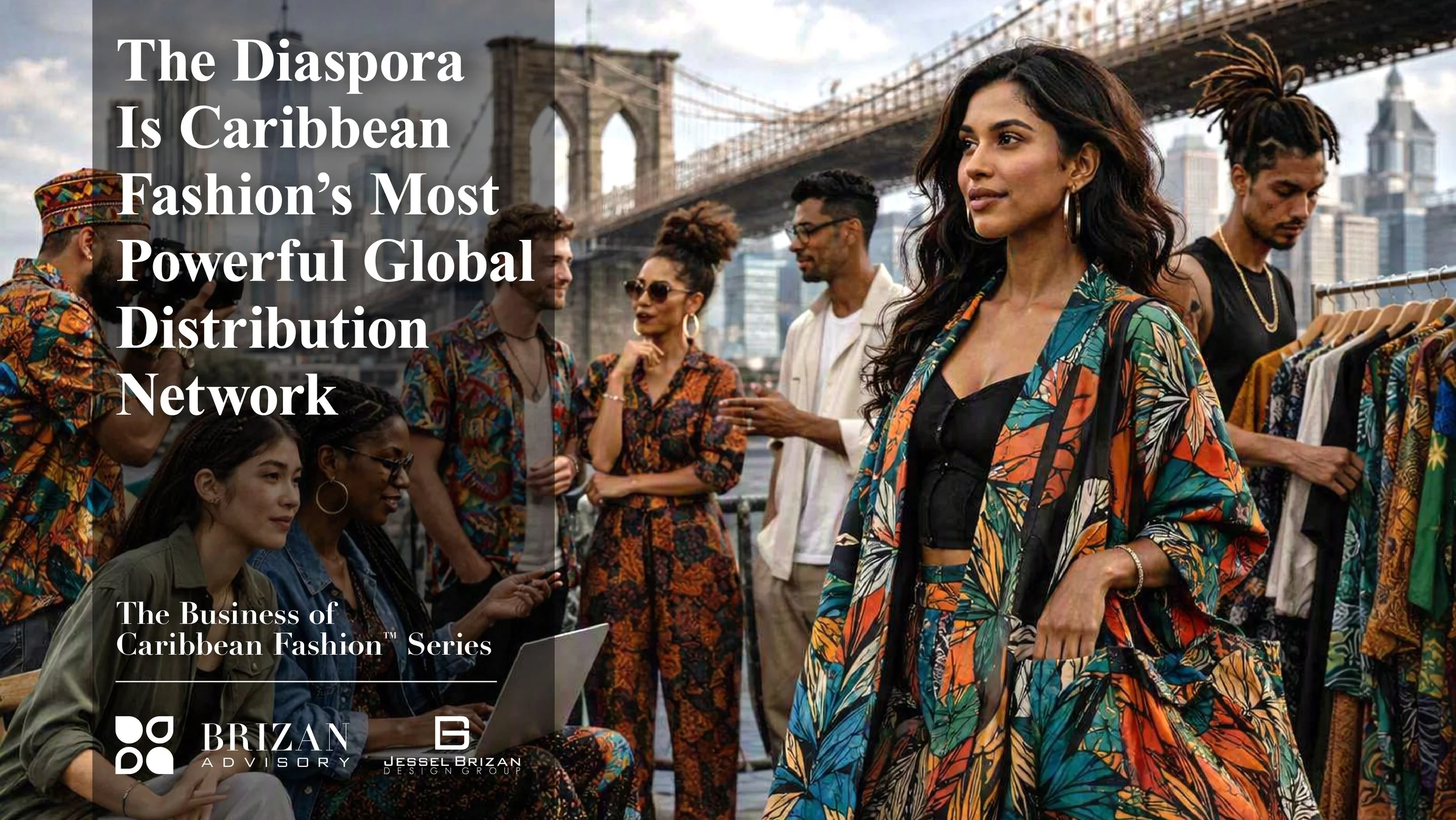
This article is part of our ‘The Business of Caribbean Fashion™’ series, inspired by Chapter 8 by Jessel Brizan, ‘Caribbean Fashion Marketing: Defining Caribbean Fashion’, in the ‘De Gruyter Handbook of Fashion Marketing’ edited by Olga Mitterfellner (De Gruyter Brill, 2026).
One of the biggest misconceptions in Caribbean fashion is that international expansion begins with finding customers overseas. Across North America, Europe, and increasingly other parts of the world, millions of people trace their heritage to the Caribbean. They maintain cultural connections, support Caribbean businesses, celebrate Caribbean traditions, attend Caribbean cultural events, consume Caribbean music, and engage with Caribbean identity in ways that transcend geography. Yet despite this enormous global community, many Caribbean fashion brands continue to approach international growth as though they are entering entirely unfamiliar markets. In fact, the Caribbean may already have one of the most valuable international distribution networks any emerging fashion industry could hope for. It is called the diaspora.
The Market Is Larger Than the Region
One of the structural challenges facing Caribbean fashion is the size of local markets. Most Caribbean countries have relatively small populations. Even the region collectively represents a modest consumer base compared to major international markets. This reality often leads fashion entrepreneurs to believe that growth depends on exporting to consumers who have little or no prior connection to the Caribbean. While global expansion remains important, this perspective overlooks a significant strategic advantage. The Caribbean's cultural footprint extends far beyond its geographic borders. Large Caribbean communities exist in cities including New York, Toronto, London, Miami, Atlanta, Amsterdam, and many others. These communities maintain strong social, cultural, familial, and economic ties to the region. In strategic terms, this means Caribbean fashion's potential market is significantly larger than the Caribbean itself. The industry's true market includes both the region and its global diaspora.
Distribution Is Often More Important Than Product
Many industries assume that growth is primarily a product challenge. In reality, it is often a distribution issue. The fashion industry provides numerous examples. History shows that exceptional products do not automatically become successful brands. They require visibility, access, networks, and channels that connect them to consumers. This is where the diaspora becomes strategically important. Diaspora communities serve as trusted networks that enhance awareness, facilitate introductions, and foster cultural familiarity. They help to reduce barriers to adoption and provide brands with a customer segment that is already familiar with many of the cultural references found in Caribbean fashion. In business strategy, reducing customer acquisition costs while increasing trust is an exceptionally valuable advantage. And the diaspora offers both.
The Global Fashion Industry Has Seen This Before
Many of the world's most successful fashion ecosystems benefited from diaspora networks during their development. Italian fashion expanded globally through generations of Italian communities that helped sustain cultural awareness, appreciation for Italian craftsmanship, and demand for Italian-made products. Israeli Jewish diaspora networks played important roles in the development of international garment industries and fashion trade throughout the twentieth century. More recently, African fashion brands have successfully leveraged diaspora communities in the United Kingdom, the United States, France, and Canada as early adopters before expanding to broader international audiences. Similarly, South Korean brands benefited from global Korean communities that helped amplify cultural exports as part of the broader Korean Wave. The pattern is consistently evident. Diaspora markets often serve as launch platforms for international growth by bridging local identity and global recognition.
Caribbean Culture Already Travels Globally
The most compelling evidence may already be visible in other Caribbean creative industries. Caribbean music commands global audiences. Carnival celebrations now take place in cities around the world, attracting participants far beyond the Caribbean community. Caribbean cuisine continues to gain international recognition. Athletes, entertainers, and cultural figures from the Caribbean hold substantial influence on a global scale. These industries demonstrate that Caribbean culture already has global appeal. Fashion should be viewed through the same lens. The challenge is creating stronger systems that translate cultural influence into commercial opportunity.
The Diaspora Is More Than Consumers
Perhaps the most significant strategic mistake is to view the diaspora solely as customers. In reality, diaspora communities represent an entire business ecosystem. Within these networks are retailers, buyers, investors, media professionals, fashion journalists, photographers, stylists, content creators, academics, entrepreneurs, technology specialists, and industry executives. These individuals can become advocates, collaborators, distributors, mentors, and partners for market entry. When viewed this way, the diaspora is seen as more than just a market. It becomes infrastructure. And infrastructure is often what determines whether industries scale successfully.
Authenticity Creates Diaspora Demand
The previous article in this series argued that authenticity has become a commercial strategy. The diaspora provides one of the strongest examples of this. Consumers with Caribbean heritage often seek products that help maintain cultural connections, express identity, celebrate heritage, and support businesses that reflect their values and experiences. Authenticity matters because it creates relevance. Brands that embrace their cultural roots are often better positioned to resonate with diaspora audiences than those attempting to imitate larger international competitors. Ironically, some Caribbean brands become more globally competitive when they become more authentically Caribbean.
From Diaspora Marketing to Diaspora Strategy
Many businesses engage with diaspora communities mainly through events and social media campaigns. This approach is insufficient. The industry requires a more strategic method. Diaspora engagement should be embedded within export strategies, investment attraction initiatives, trade promotion programmes, fashion weeks, cultural festivals, tourism campaigns, and digital transformation strategies. Governments, trade agencies, industry associations, and fashion entrepreneurs should work together to map diaspora networks and identify opportunities for collaboration. The objective should be to move beyond diaspora marketing and toward diaspora strategy. The former focuses on promotion while the latter focuses on growth.
Building a Global Caribbean Fashion Ecosystem
A. R. Bernard, founder, CEO and pastor of the Christian Cultural Center megachurch in Brooklyn, New York, often reiterates, “We grow in community, not in isolation.” Likewise, the most successful creative industries rarely grow in isolation. They develop ecosystems. The Caribbean fashion industry needs to adopt a similar mindset. Rather than viewing international expansion as a series of disconnected market-entry efforts, the industry should focus on building a connected global network anchored by Caribbean communities around the world. Digital commerce has made it easier than ever for businesses to connect with a global audience. A designer in Trinidad and Tobago can now reach customers in cities like Toronto, London, New York, or Amsterdam almost instantly. The key challenge now is to strategically coordinate these individual connections to create a broader ecosystem.
The Opportunity Ahead
Much of the debate about Caribbean fashion has centred on limited local markets, constrained resources, and barriers to international expansion. While those challenges are real, they can obscure a much larger opportunity. Few emerging fashion industries have millions of people around the world who already understand their culture, appreciate their identity, and maintain emotional connections to their heritage. The Caribbean is one such industry. The question is whether the industry is prepared to leverage that advantage. And in a world where distribution increasingly determines success, that network may be one of the Caribbean fashion industry's most valuable strategic assets. The future of Caribbean fashion will be shaped not just by global outreach, but also by reconnecting with the Caribbean people who are already connected to the region through family, culture, identity, and heritage.
Click here to review The Business of Caribbean Fashion™ series.
Click here to order a copy of the De Gruyter Handbook of Fashion Marketing.

Archive
- October 2026
- September 2026
- August 2026
- July 2026
- June 2026
- May 2026
- April 2026
- March 2026
- February 2026
- October 2025
- September 2025
- July 2025
- May 2025
- March 2025
- September 2023
- August 2023
- June 2023
- May 2023
- January 2023
- September 2022
- February 2022
- May 2021
- April 2021
- March 2021
- December 2020
- October 2020
- August 2020
- July 2020
- June 2020
- March 2020
- September 2019
- June 2019
- May 2019
- March 2019
- February 2019
- September 2018
- September 2016
- January 2016