
What Does It Mean for a Caribbean Fashion Brand to Be Buyer-Ready?
by Jessel Brizan | VALSAYN, Trinidad and Tobago | 23 November 2026
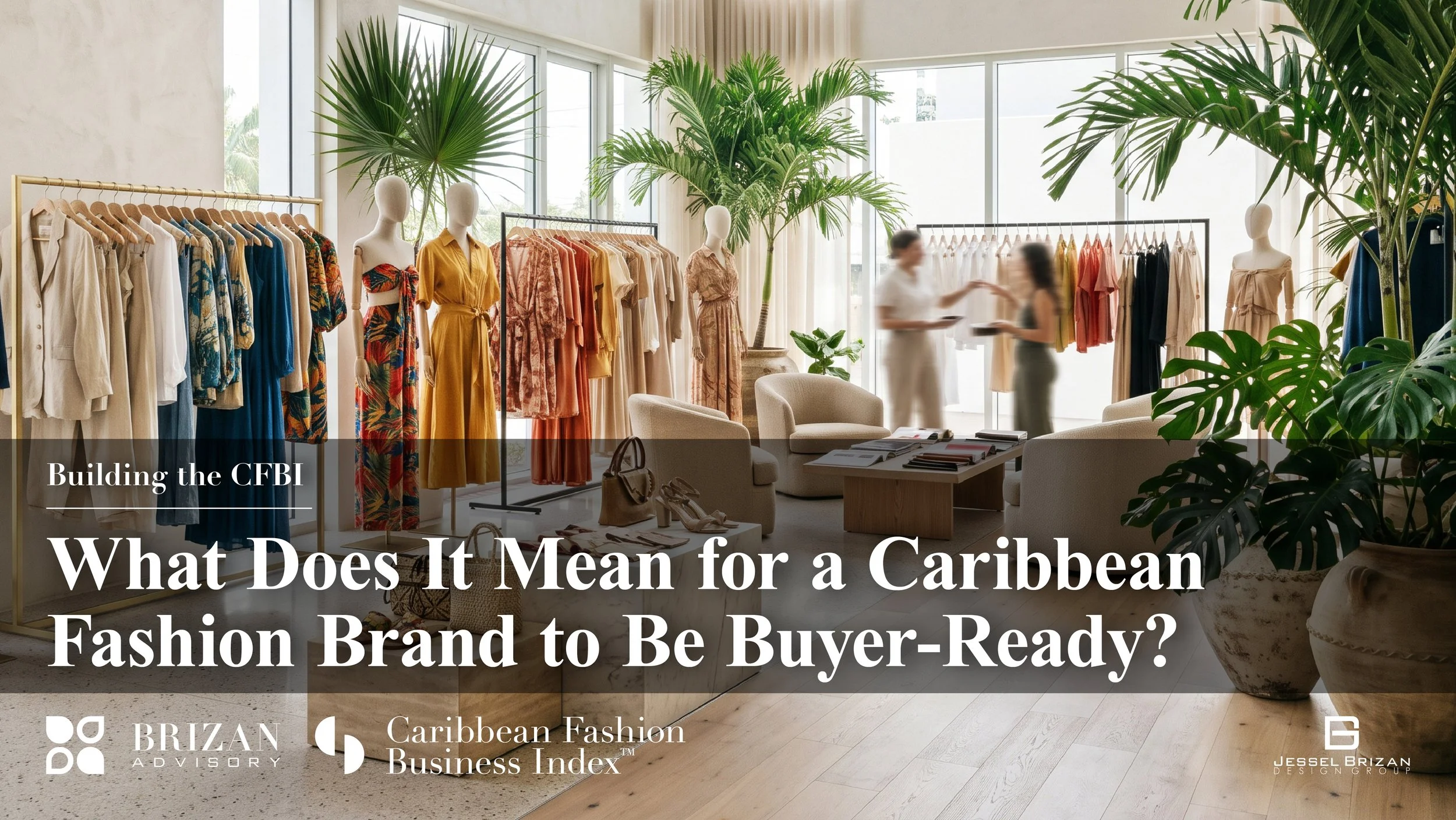
This article is part of our ‘Building the CFBI’ series.
A fashion buyer may admire a collection for its cultural relevance and the designer's talent, but these factors do not guarantee a wholesale order. For retailers, selecting a fashion brand is a commercial decision that requires the product to appeal to customers, fit the pricing structure, meet quality standards, and be delivered on time and in the agreed quantities.
Caribbean fashion businesses looking to expand beyond direct-to-consumer sales must understand that buyer readiness goes beyond creating attractive collections or participating in international trade shows. It involves consistently, profitably and professionally meeting buyers' commercial requirements.
The Caribbean Fashion Business Index™ (CFBI) is being developed to analyse the conditions affecting fashion enterprises in the region. A key focus is buyer readiness, which is vital to commercial viability. Understanding this concept helps designers identify the gap between having a marketable product and being prepared to supply retail partners.
From Creative Appeal to Commercial Fit
Retail buyers select collections based on the target customer, price point, season, and merchandising strategy. A collection can be unique yet still unsuitable for a potential stockist if its price, product mix, or aesthetic does not align with the retailer’s positioning.
A buyer-ready brand must clearly understand its target market and competitive position. It should identify potential customers, assess their needs, and recognise existing alternatives. It must also explain why a retailer should allocate limited shelf space or online visibility to its brand.
Beyond a compelling brand story, designers must demonstrate customer interest, sales performance, and product-market fit. Direct-to-consumer sales, customer feedback, repeat purchases, and targeted market tests can indicate whether demand extends beyond personal networks and social media.
In its 2026 report, The Business of Fashion highlights that buyers seek market fit, demonstrated demand, strategic pricing, and reliable operations from emerging designers (BoF, 2026). Creative differentiation can attract attention, but strong commercial evidence is essential to making a buying decision.
For Caribbean designers, this means translating cultural identity and creativity in a way that is understandable to customers and marketable for retailers. The objective is to clarify the brand's value without compromising its identity.
Pricing Must Work for Both Sides
Pricing is a key indicator of buyer readiness. A product that sells profitably on a brand's own website or in its studio may not be viable for wholesale.
Retailers usually need a buying price that leaves a sufficient profit margin to cover their operating costs and provide a return. Therefore, designers must understand the relationship between production costs, wholesale prices, and retail prices, including materials, labour, packaging, and overhead.
This is particularly important in Caribbean markets, where small production runs, imported materials, shipping costs, and limited access to specialised suppliers complicate pricing. Designers who add only a small markup to material costs often overlook labour, development, administration, and the costs of producing future collections. The result can be a business that appears successful yet loses money on every wholesale order.
Designers must also know the minimum order quantity, acceptable discount levels, and the target profit margin. The key question is whether the price structure supports a sustainable relationship between the retailer and designer.
Can the Business Deliver?
A buyer places an order on the understanding that the products will arrive as agreed. Therefore, production capacity, lead times, quality, and communication are crucial to buyer readiness.
When a business moves from small-scale, made-to-order production to wholesale orders, it should consider the following questions:
Can the brand meet the required quantity within the delivery timeframe?
Are the necessary materials readily available, or will they need to be imported?
Can the business consistently reproduce a design across different sizes and units?
What procedures are in place to address supplier delays or a production batch that fails to meet quality standards?
McKinsey & Company’s 2024 research on apparel sourcing identifies supply chain volatility, efficiency, resilience, and sustainability as key considerations for fashion businesses and their sourcing partners. Although the study primarily focuses on larger global industry players, its insights are applicable to smaller brands. The key takeaway is that reliable delivery depends on robust systems, strong supplier relationships, and clear visibility throughout the production process (McKinsey & Company, 2024).
A buyer-ready business should be able to present realistic production capacity and timelines, product specifications, and quality-control procedures, and maintain consistent communication. It should accept only orders it can fulfil without compromising quality, cash flow, or existing commitments.
Professional Standards and Responsible Business Practices
Buyer readiness encompasses the documentation retailers need to assess a brand and its products. This may include product specifications, size charts, material composition, care instructions, labelling information, invoices, production terms, and proof of regulatory compliance.
Sustainability and responsible sourcing are increasingly important in the garment and footwear sector. The OECD’s 2025 analysis of sustainability certifications examines how they can support, but not replace, comprehensive due diligence throughout the supply chain (OECD, 2025). Caribbean brands should understand the origins of materials, maintain accurate product information, and verify any environmental or ethical claims, rather than relying on vague claims.
A buyer-ready business should have clear commercial terms that cover payment schedules, order quantities, delivery dates, returns, defective goods, and intellectual property, helping minimise misunderstandings and protect both parties.
The Financial Capacity to Accept an Order
Securing an order does not automatically improve a fashion business’s financial position. Wholesale customers often pay after delivery, so designers must cover material, production, and shipping costs before receiving full payment.
This creates a working capital challenge, where a brand may have a profitable order on paper but insufficient cash to fulfil it.
Before accepting an order, designers should prepare a cash flow forecast, calculate upfront funding requirements, and understand the buyer's payment terms. Options such as deposits, staged payments, or financing can help manage cash flow, depending on the buyer, the contract, and the brand's financial position.
The Caribbean Development Bank has identified limited data, capacity-building needs, financing barriers and market-access constraints as challenges facing Caribbean creative enterprises. Through its Cultural and Creative Industries Innovation Fund, the bank emphasises the need to strengthen business capabilities to help creative potential translate into commercial success (CDB, 2024).
Designers should understand the growth implications before committing, so that they can secure and fulfil orders without creating cash-flow problems.
How the CFBI Can Help Buyer Readiness
To achieve buyer readiness, designers should consider the underlying conditions that enable a business to engage buyers effectively. These include product-market fit, pricing and margins, production capacity, delivery reliability, financial management, documentation, and access to suitable sales channels.
The CFBI will serve as a regional framework for assessing factors such as buyer readiness, commercial viability, sustainability, talent, digital infrastructure, and the policy environment.
The proposed pilot across Trinidad and Tobago, Jamaica, Barbados, and Guyana aims to test the framework, assess data availability, and refine the methodology before conducting a comprehensive assessment of the Caribbean fashion industry. The objective is to determine what can be measured consistently and where further evidence is needed.
A structured approach can help businesses identify capability gaps and guide industry support organisations in developing relevant training and assistance programmes. However, conclusions depend on the quality and scope of the data.
Readiness Is a Business Capability
Caribbean fashion is characterised by creative talent, unique cultural perspectives, and the potential to reach customers in international markets. Businesses must understand their customers, price products appropriately, manage production, maintain adequate cash flow, and fulfil their commitments.
Buyer readiness does not guarantee an order, and not every designer needs to pursue wholesale. Alternative sales channels, such as direct-to-consumer sales, made-to-order production, and collaborations, may be better suited to certain business models. The priority is to select the right market strategy and build the capabilities to support it.
Designers seeking retail partnerships should ensure their business infrastructure is ready to sell, deliver, and scale effectively.
The future of Caribbean fashion depends on connecting creativity with commerce. Improved data can identify gaps, while stronger business systems can help close them.
Click here to help build the CFBI.
Follow the Building the CFBI series for updates as the Caribbean Fashion Business Index™ pilot progresses toward publication.
References
The Business of Fashion (BoF) (2026) What Buyers Really Want From Emerging Designers. Available at: https://businessoffashion-businessoffashion-prod.web.arc-cdn.net/articles/retail/what-buyers-really-want-from-emerging-designers/
Caribbean Development Bank (2024) Data Gaps Hindering Measurement of Cultural and Creative Industries Impact on Caribbean Development. Available at: https://www.caribank.org/newsroom/news-and-events/data-gaps-hindering-measurement-cultural-and-creative-industries-impact-caribbean-development
McKinsey & Company (2024) Reimagining the apparel value chain amid volatility. Available at: https://www.mckinsey.com/industries/retail/our-insights/reimagining-the-apparel-value-chain-amid-volatility
OECD (2025) The role of sustainability certifications in due diligence in the garment and footwear sector. Available at: https://www.oecd.org/en/publications/the-role-of-sustainability-certifications-in-due-diligence-in-the-garment-and-footwear-sector_ac8179f2-en.html
Archive
- November 2026
- October 2026
- September 2026
- August 2026
- July 2026
- June 2026
- May 2026
- April 2026
- March 2026
- February 2026
- October 2025
- September 2025
- July 2025
- May 2025
- March 2025
- September 2023
- August 2023
- June 2023
- May 2023
- January 2023
- September 2022
- February 2022
- May 2021
- April 2021
- March 2021
- December 2020
- October 2020
- August 2020
- July 2020
- June 2020
- March 2020
- September 2019
- June 2019
- May 2019
- March 2019
- February 2019
- September 2018
- September 2016
- January 2016