
The Caribbean Is Not One Market
by Jessel Brizan | VALSAYN, Trinidad and Tobago | 16 November 2026
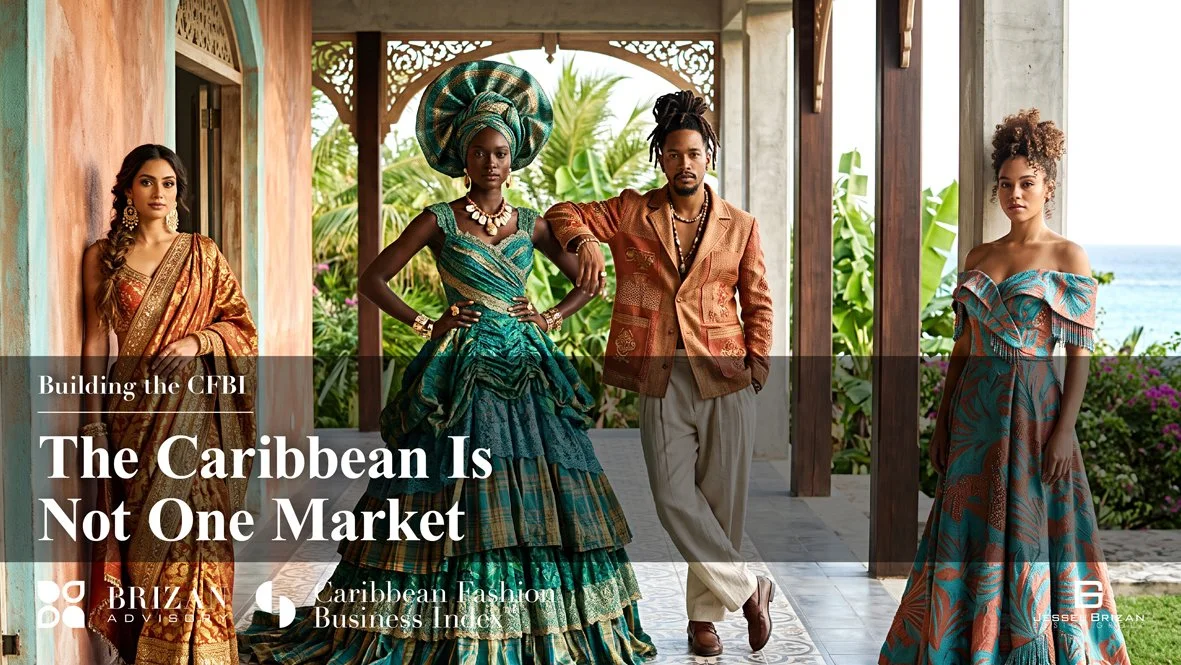
This article is part of our ‘Building the CFBI’ series.
The Caribbean is often regarded as a unified cultural and economic region, characterised by shared histories, artistic traditions, regional institutions, and an international diaspora. This provides a solid foundation for fashion businesses targeting customers beyond their local markets.
However, a shared Caribbean identity does not automatically translate into a single, accessible market.
A fashion business that succeeds in Trinidad and Tobago cannot assume that its pricing, distribution strategy, product offerings, or sales channels will perform equally well in Jamaica, Barbados, or Guyana. Each market has distinct consumer preferences, production capabilities, shipping costs, and retail structures, creating unique commercial conditions.
For Caribbean fashion entrepreneurs, investors and policymakers, recognising these differences is essential. Beyond identifying a larger potential customer base, regional expansion requires understanding how each market operates and what businesses need to compete successfully.
Therefore, a key consideration in developing the Caribbean Fashion Business Index™ (CFBI) is how the region can establish a unified framework for assessing fashion business performance while recognising the differences across territories.
One Region, Different Business Environments
The Caribbean offers opportunities for regional trade, but businesses operate within distinct national economic environments. This disparity extends to the scale of domestic demand, the availability of suppliers, the cost of doing business and the maturity of commercial infrastructure.
For example, a Trinidad and Tobago fashion label expanding into Jamaica may need to adapt its customer base, pricing, and promotional strategies, and may require different retail partnerships, market research, and logistics planning.
Commercial success depends on the interaction between the product and the market.
Every expansion decision requires an evaluation of demand, competitive positioning, operating costs, and the practical capacity to serve customers.
A regional strategy that assumes these conditions are interchangeable may conflate geographic proximity with commercial accessibility.
The Difference Between Cultural Connection and Market Demand
An important advantage for Caribbean fashion lies in the region's cultural expressions, creative talent, and distinctive design perspectives, which can forge connections with consumers both locally and internationally.
However, cultural relevance does not equate to market demand.
A product may resonate with a consumer's identity yet be unaffordable due to high production costs. Likewise, a design can attract attention at a fashion event without translating into sales. Additionally, a diaspora audience may express interest in a product, but reaching them through existing distribution channels can be challenging and costly.
Businesses must therefore test whether cultural interest translates into willingness to pay, repeat demand, and commercially viable sales. This requires information specific to the market.
Who is the target customer?
What price can they afford?
Which sales channels generate sales?
How frequently do customers purchase?
What prevents interested consumers from completing a transaction?
The Infrastructure Behind Regional Expansion
Beyond consumer demand, market differences affect the fashion supply chain.
Businesses may have varying levels of access to textiles, trims, specialised labour, manufacturing facilities, logistics services, and production equipment. These factors affect costs, lead times, minimum order quantities, and the ability to maintain consistent quality.
A designer placing a large order may find local production capacity insufficient. Another designer may produce locally but struggle to source materials at competitive prices. Additionally, a business with export potential may lack the working capital or logistics to fulfil international orders.
The Caribbean Development Bank’s 2024 discussion on data gaps in the cultural and creative industries highlighted the difficulty of measuring the sector’s economic contribution. The Bank has also documented constraints facing smaller creative enterprises, including access to finance, capacity building, industry networks, data, and markets (CDB, 2024).
CARICOM's intra-regional trade statistics provide reliable data on trade among member states. However, these broad statistics alone do not fully capture the fashion industry's performance and challenges, which require sector-specific insights (CARICOM Regional Statistics, n.d.).
Why Regional Benchmarking Must Be Designed Carefully
Because the Caribbean is not a single market, benchmarking must be designed to distinguish between common measures and local conditions.
The following questions are relevant across all territories.
Are businesses pricing products to cover their costs?
Do they have reliable financial records?
Can they fulfil orders consistently?
Do they use digital channels to reach customers?
Are they prepared to meet the requirements of their target audience?
At the local level, key questions include:
What financing options are available?
How accessible are production facilities?
What logistics constraints affect delivery?
What support programs exist?
What regulatory or administrative requirements influence business operations?
Without clear definitions, it is difficult to compare results effectively. However, without context, comparisons can be misleading. For instance, a lower score in one area should not be taken as evidence of weaker entrepreneurship if businesses there face different challenges, such as poor infrastructure or limited market access.
The objective should be to identify patterns, understand differences, and determine where targeted interventions could improve business performance.
Building the Evidence Through the CFBI
The proposed CFBI framework comprises six measurement areas: Commercial Viability and Financial Health; Market and Buyer Readiness; Compliance and Sustainability; Talent Capacity and Skills; Market Access and Digital Infrastructure; and Policy and Ecosystem Environment.
The initial pilot is being launched in Trinidad and Tobago, Jamaica, Barbados, and Guyana. These markets will be used to test indicators, assess data availability, and refine a methodology for meaningful analysis across the region.
The pilot programme is not intended to prove that these four markets represent the entire Caribbean. Any differences observed in this limited sample should not be taken as definitive national rankings. Conclusions will depend on participation levels, data quality, and market conditions.
The goal is to assess whether a consistent framework can capture valuable information across different operating environments. Regular data collection may reveal common challenges across markets, territory-specific issues, and opportunities for regional cooperation.
The findings are intended to inform the proposed Caribbean Fashion Outlook, a publication that would provide analysis for entrepreneurs, policymakers, investors, and industry support organisations.
From Regional Identity to Regional Strategy
Businesses need to understand where their products have credible demand, the cost of serving those customers, and the capabilities they must develop before expanding. Investors need better information on commercial readiness and operating risks. Policymakers and development institutions need evidence to distinguish between common regional constraints and challenges that require national responses.
The UN Trade and Development's Creative Economy Outlook 2024 reported that global exports of creative services reached $1.4 trillion in 2022, while creative goods exports totalled $713 billion. These figures highlight the scale of international creative trade and the need for businesses to understand how to access commercial opportunities (UNCTAD, 2024).
The Caribbean shares a creative identity, but its fashion businesses operate in different commercial realities. A regional industry strategy must recognise both realities.
Click here to help build the CFBI.
Follow the Building the CFBI series for updates as the Caribbean Fashion Business Index™ pilot progresses toward publication.
References:
CARICOM Regional Statistics (n.d.) CARICOM Intra-Regional Trade. Available at: https://statistics.caricom.org/data_categories/caricom-intra-regional-trade/
Caribbean Development Bank (CDB) (2024) Data Gaps Hindering Measurement of Cultural and Creative Industries Impact on Caribbean Development. Available at: https://www.caribank.org/newsroom/news-and-events/data-gaps-hindering-measurement-cultural-and-creative-industries-impact-caribbean-development
UN Trade and Development (UNCTAD) (2024) Creative Economy Outlook 2024. Available at: https://unctad.org/publication/creative-economy-outlook-2024

Archive
- November 2026
- October 2026
- September 2026
- August 2026
- July 2026
- June 2026
- May 2026
- April 2026
- March 2026
- February 2026
- October 2025
- September 2025
- July 2025
- May 2025
- March 2025
- September 2023
- August 2023
- June 2023
- May 2023
- January 2023
- September 2022
- February 2022
- May 2021
- April 2021
- March 2021
- December 2020
- October 2020
- August 2020
- July 2020
- June 2020
- March 2020
- September 2019
- June 2019
- May 2019
- March 2019
- February 2019
- September 2018
- September 2016
- January 2016