
Creativity Is Not the Same as Commercial Viability
by Jessel Brizan | VALSAYN, Trinidad and Tobago | 9 November 2026
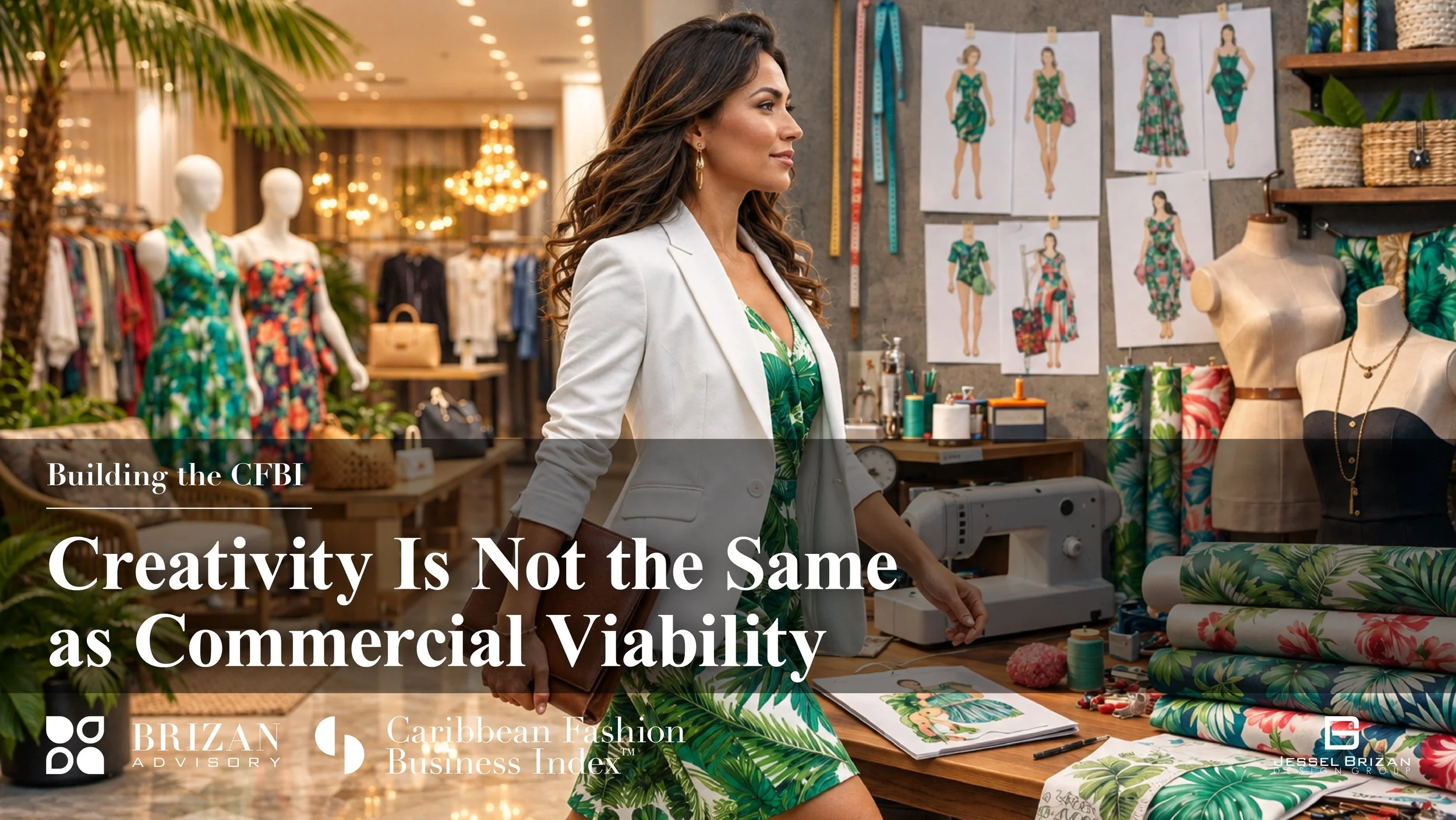
This article is part of our ‘Building the CFBI’ series.
A fashion collection can be beautifully designed and culturally relevant but still struggle to generate sustainable income. A designer may attract social media attention, receive invitations to fashion shows, and earn praise from customers, yet fail to build a business that covers costs, fulfils orders, or finances future collections.
The key distinction is that creative potential does not guarantee commercial success.
This highlights the need to view fashion as both a creative practice and an economic activity. If the Caribbean wants its fashion industry to effectively contribute to employment, enterprise development, trade, and economic diversification, it must understand what enables creative businesses to be commercially sustainable.
This requires looking beyond visibility and talent to the underlying business model.
The Gap Between Visibility and Viability
The fashion industry operates in a marketplace where attention is often mistaken for success. A runway appearance, a celebrity endorsement, or a large social media following can generate exposure, but none of these alone indicates a business's profitability or growth potential.
The economics of fashion are demanding. Businesses must account for materials, labour, sampling, product development, manufacturing, packaging, freight, marketing, distribution, and selling costs, and manage inventory, cash flow, pricing, and the timing of customer payments.
A designer can sell an entire collection yet still earn insufficient returns if prices do not cover production and selling costs. Another may receive a large wholesale order but lack the working capital to purchase materials and pay production costs before payment is received. Additionally, some may have strong seasonal sales but struggle to maintain income for the rest of the year.
These are not necessarily failures of creativity but challenges of the business model.
The key question is not only whether Caribbean fashion businesses create appealing products, but also whether they can consistently translate their creativity into revenue, healthy profit margins, reliable operations, and sustainable growth.
The Commercial Fundamentals
Commercial viability begins with a clear understanding of costs and pricing. Businesses need to know the costs of developing, producing, distributing and selling each product, as well as the remaining profit margin. Without this information, pricing decisions may be driven by competitors, customer expectations or intuition rather than by commercial requirements.
Revenue alone is an incomplete measure of performance. A business with high sales can still be unprofitable, whereas a smaller enterprise with controlled costs, loyal customers, and healthy profit margins may have a more resilient business model.
Cash flow is equally important. The timing of expenses and income directly affects a business’s ability to fulfil orders, pay suppliers, and invest in future production cycles. Businesses often need to spend on materials and labour before receiving payments from customers.
Market demand is essential. A unique product requires a substantial customer base willing to pay a profitable price. Commercially viable businesses must understand their target markets, buying behaviour, competition, and distribution channels.
Finally, growth requires operational capacity. Businesses targeting wholesale, export, or larger institutional orders must consider production volumes, consistent quality, delivery schedules, and the ability to meet buyers' requirements. Opportunities that undermine profitability are less commercially attractive.
These capabilities are interconnected. Pricing depends on production costs, market opportunities require an understanding of fulfilment capacity, and sustainable growth relies on adequate cash flow and effective management.
Why the Financing Issue is Important
The difference between creative potential and commercial viability also affects access to financing.
In March 2022, the Caribbean Development Bank (CDB) reported a knowledge gap between creative entrepreneurs seeking loans and the financial institutions assessing creative-sector enterprises (CDB, 2022). CDB’s response included training for finance officers to improve their assessment of applications. This initiative emphasises that lenders need to understand both the creative potential and the financial position of these enterprises.
This does not mean that every fashion business should seek external financing. Many can improve cash flow, refine pricing, optimise inventory management, or validate demand before borrowing. Others may need working capital or equipment to fulfil larger orders.
The appropriate intervention depends on the business’s specific constraints. Financial support cannot indefinitely cover weak margins, uncertain demand, or poor management. Similarly, a viable business may remain small due to insufficient capital to scale production or enter new markets.
Distinguishing between these situations requires improved business information.
You Cannot Fix What You Cannot Measure
Creative enterprise development programmes often focus on skills, mentorship, visibility, and market access. However, their effectiveness depends on an accurate diagnosis of the problem.
A business struggling with sales may face a product-market fit issue rather than a marketing problem. If a business cannot fulfil orders, it may need better production planning and working capital rather than more exposure. Likewise, a business with rising revenue but declining profitability may need improved costing and financial management rather than focusing on expansion.
Without reliable information on business conditions, support can become generic, making it challenging for policymakers and development institutions to identify effective solutions.
UN Trade and Development's Creative Economy Outlook 2024 highlights the economic significance of creative industries and examines the effects of digitalisation, competition, and sustainability (UNCTAD, 2024). Although the findings focus on the wider creative economy, they emphasise the importance of understanding the conditions that enable creative activities to translate into economic opportunities.
For Caribbean fashion, the challenge is to gather sector-specific evidence that connects business performance to the conditions that shape it.
Measuring What Matters
This is the rationale for the Caribbean Fashion Business Index™ (CFBI), which is being developed as a regional market intelligence and benchmarking initiative. Its proposed framework covers six areas:
Commercial Viability and Financial Health
Market and Buyer Readiness
Compliance and Sustainability
Talent Capacity and Skills
Market Access and Digital Infrastructure
Policy and Ecosystem Environment
Together, these areas are designed to assess both business performance and the capabilities and external conditions that may influence it.
The pilot is being developed across Trinidad and Tobago, Jamaica, Barbados, and Guyana to test indicators, evaluate data availability, and refine the methodology. It should not be viewed as a comprehensive assessment of the Caribbean fashion industry, nor as validated until the project is completed.
The long-term goal is to help fashion entrepreneurs, investors, policymakers, and industry support organisations make more informed decisions. Better evidence can distinguish between businesses that need foundational support and those ready to expand, while also identifying broader challenges that individual enterprises cannot resolve.
From Creative Potential to Commercial Performance
The Caribbean needs to recognise that creativity and commerce serve complementary roles, rather than choosing between them.
Creativity generates ideas, products, identity, and differentiation, while commercial capability turns these strengths into sustainable enterprises. However, neither guarantees success on its own.
The goal is to create an environment that fosters designers' creativity while providing the financial, operational, and market capabilities required to compete. It starts with asking better questions:
Are businesses pricing sustainably?
Can they fulfil orders reliably?
Do they understand their customers?
Are they generating sufficient profit margins?
What prevents them from accessing finance, developing production capacity or entering new markets?
While the answers may vary across the region, developing a credible method for investigating these questions is a crucial step towards providing more targeted support and improving overall business performance.
The future of Caribbean fashion depends on both regional creativity and the ability to establish commercially viable businesses.
Click here to help build the CFBI.
Follow the Building the CFBI series for updates as the Caribbean Fashion Business Index™ pilot progresses toward publication.
References:
Caribbean Development Bank (CDB) (2022) CDB preps banks for lending to creatives. Available at: https://www.caribank.org/newsroom/news-and-events/cdb-preps-banks-lending-creatives
UN Trade and Development (UNCTAD) (2024) Creative Economy Outlook 2024. Available at: https://unctad.org/publication/creative-economy-outlook-2024
Archive
- November 2026
- October 2026
- September 2026
- August 2026
- July 2026
- June 2026
- May 2026
- April 2026
- March 2026
- February 2026
- October 2025
- September 2025
- July 2025
- May 2025
- March 2025
- September 2023
- August 2023
- June 2023
- May 2023
- January 2023
- September 2022
- February 2022
- May 2021
- April 2021
- March 2021
- December 2020
- October 2020
- August 2020
- July 2020
- June 2020
- March 2020
- September 2019
- June 2019
- May 2019
- March 2019
- February 2019
- September 2018
- September 2016
- January 2016